
All-on-4 Dental Implants
All-on-4 is a specific full-arch protocol: four implants per jaw, with the two rear implants angled forward so they engage denser bone toward the front. That angle is what often avoids a sinus lift. A provisional bridge can be fitted the same day when the implants seat firmly enough.
By DICHB editorial teamPrepared from established dental references · clinical review by Dr. Sameer Aljanedi pendingUpdated
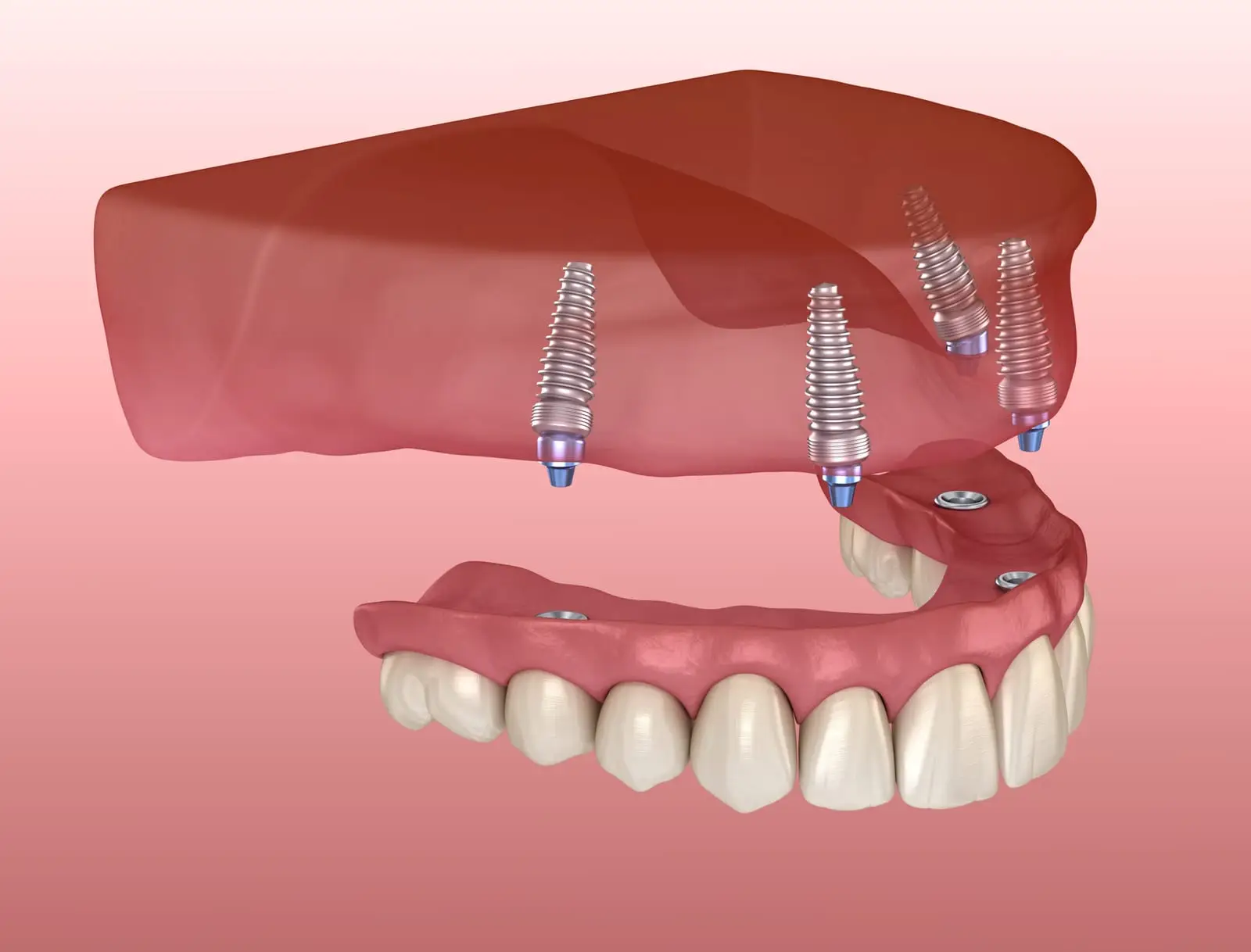
Illustration for education — not a patient case.
- Implants per arch
- Four — Cleveland Clinic describes All-on-4 as replacing an entire arch using just four implants
- Rear implant angle
- Tilted forward to engage denser anterior bone and steer clear of the sinus and nerve canal
- Grafting
- Tilted plus upright implants can avoid grafting in qualifying cases (five-year retrospective study); the scan decides
- Four vs. six implants
- Two-year survival 98.6% vs. 98.8%, five-year 98.4% vs. 98.7% — comparable in a large retrospective analysis
- Same-day teeth
- A provisional bridge when stability allows; the ADA notes others wait up to several months
- Integration
- Three to nine months per Cleveland Clinic before the final bridge
On this page
What the All-on-4 protocol actually specifiesLink to this section: What the All-on-4 protocol actually specifies
All-on-4 is the name of a particular arrangement of implants, not a brand of tooth. Four implants carry one fixed bridge across an entire upper or lower jaw. The two implants at the front are placed upright, and the two at the back are tilted forward, so the bridge is supported at four widely spaced points rather than one implant per tooth.
Cleveland Clinic describes All-on-4 as a method that replaces an entire arch of missing teeth using just four dental implants. That is the whole premise: use the bone that reliably survives tooth loss, near the front of the jaw, and reach backward from it.
This page is about that four-implant protocol specifically. If you are still choosing between fixed teeth, a removable snap-in denture, and saving some natural teeth, start with the broader guide to full-arch dental implants, which compares the designs side by side.
Why the two rear implants are angledLink to this section: Why the two rear implants are angled
Bone at the back of the jaw is the part that tends to disappear first. In the upper jaw the maxillary sinus expands downward once the molars are gone; in the lower jaw the nerve canal runs through the region where a molar implant would sit. Both limit how much length a straight implant can find back there.
Tilting solves that geometrically. An angled implant enters in front of the obstacle and travels backward through denser bone, so its head emerges further back in the arch than an upright implant of the same length could. The bridge gets a wider footprint, and no straight post has to enter the sinus or approach the nerve.
A retrospective study of 212 implants in 53 full-arch rehabilitations, followed for up to five years, reported that combining tilted and upright implants allows fixed rehabilitation of edentulous arches while avoiding the need to perform bone grafting procedures, and found no statistically significant differences in success rate between tilted and upright implants. Often avoids is the honest phrase, not always. The 3D scan decides, and some upper cases still need a sinus lift or other bone grafting before implants can be placed.
Provisional teeth on the day of surgeryLink to this section: Provisional teeth on the day of surgery
Most All-on-4 cases are planned so a temporary acrylic bridge is screwed on at the end of the surgical visit. Whether that happens depends on how firmly each implant seats in the bone during placement, which nobody can promise in advance. The ADA notes that some patients receive implants and replacement teeth in one visit, while others wait up to several months before the teeth are attached.
What goes on that day is a provisional. It is lighter, made of acrylic, and designed to be worn on a soft diet while the bone fuses around the posts. Cleveland Clinic describes that fusion, osseointegration, taking anywhere from three to nine months. The final bridge is made after it. What "teeth in a day" does and does not cover is unpacked in same-day dental implants.
All-on-4, All-on-6, and All-on-XLink to this section: All-on-4, All-on-6, and All-on-X
All-on-X is the umbrella term for the same design with the implant count chosen from your anatomy. All-on-6 adds two more posts, spreading the load further back and giving the bridge more support if one implant were ever lost.
More implants are not automatically better. A large retrospective comparison of four- versus six-implant fixed complete dentures reported two-year cumulative survival of 98.6 percent for four implants and 98.8 percent for six, and five-year survival of 98.4 percent and 98.7 percent, describing the results as comparable with no statistically significant difference. The authors used a structured decision system weighing anatomic, systemic, surgical, and prosthodontic factors alongside risks like smoking and bruxism.
In practice, six is often chosen for weaker bone, a long arch, heavy clenching, or a bridge material that wants more support. Four is chosen when the front bone is solid and the arch is straightforward. The comparison is developed in All-on-4 vs. All-on-6, and the counting question in how many implants a full arch needs.
Who the four-implant protocol suitsLink to this section: Who the four-implant protocol suits
The typical candidate has lost, or is about to lose, every tooth in an arch and wants teeth that do not come out. Long-time denture wearers tired of adhesive and people whose remaining teeth are failing together are the two most common starting points.
Bone toward the front of the jaw is the make-or-break variable, because that is where all four implants find their anchorage. Cleveland Clinic lists active gum disease, severe jawbone loss, unmanaged diabetes, and smoking or vaping among the reasons someone may not be a good candidate. The AAOMS puts the overall success rate of dental implants at 95 percent, which is a population figure rather than a personal prediction. Broader criteria are in who is a candidate for dental implants.
What the surgical visit involvesLink to this section: What the surgical visit involves
Planning starts with a 3D scan, photographs, and usually a trial of the new tooth position so the bite and smile are agreed before anything is placed. A guide made from that scan positions each implant at its planned angle.
Surgery is one visit under local anesthesia, with sedation available at the affiliated offices. Any remaining teeth in the arch are removed, the ridge is contoured, four implants are placed, and the provisional is attached if stability allows. If it does not, a denture is worn while the sites heal, and the bridge follows later.
Living with a four-implant bridgeLink to this section: Living with a four-implant bridge
A fixed bridge on four implants is cleaned at home every day with a soft brush, a water flosser, and floss or interdental brushes where the bridge meets the gum. Cleveland Clinic ties implants lasting a lifetime to brushing, flossing, and regular dental visits. Plan on professional maintenance visits where the bridge may be unscrewed, cleaned, and re-seated. The routine is detailed in caring for dental implants.
Consultation in Huntington BeachLink to this section: Consultation in Huntington Beach
Whether four implants are enough for your arch is a scan question, and the affiliated offices in Huntington Beach and Downey list All-on-4 and All-on-X treatment, 3D imaging, and sedation among their services. Beachside Dental Group publishes a free consultation including full-mouth X-rays and an examination, and a $699 dental implant placement offer covering placement, exam, and X-rays for new patients, with abutments, the bridge, and sedation priced separately; offers cannot be combined with insurance and may change.
Because a full arch bundles extractions, four implants, a provisional, and a final bridge, ask for a written, itemized plan before comparing anything. See dental implant cost. Request a consultation when you are ready.
When All-on-4 is not the right protocolLink to this section: When All-on-4 is not the right protocol
- Bone at the front of the jaw is too thin or too short for four implants at the planned angles, and grafting is declined.
- Several natural teeth are healthy and savable. Extracting sound teeth to fit the design is a trade most dentists advise against.
- Heavy grinding, a long arch, or poor bone quality where the dentist recommends six implants instead.
- You would rather be able to take your teeth out to clean them, in which case an implant-supported overdenture may suit you better.
- Smoking, unmanaged diabetes, or untreated gum disease that has not been addressed before surgery.
Benefits
- A full arch of fixed teeth on four implants rather than one per tooth
- Angled rear implants often reach usable bone without a sinus lift
- A provisional bridge can be attached at the surgical visit when implants seat firmly enough
- Nothing to remove at night, no adhesive, and no palate coverage in the upper jaw
- Survival in published series is comparable to six-implant designs
Limitations & considerations
- Same-day provisional teeth depend on stability measured at surgery and cannot be promised beforehand
- Four implants leave less redundancy than six if one is ever lost
- Angled placement reduces but does not eliminate the need for grafting or a sinus lift
- Cleaning under a fixed bridge takes a water flosser and regular professional maintenance
- Heavy clenching, a long arch, or soft bone may push the recommendation to six implants
What the process looks like
3D planning and tooth try-in
A cone-beam scan, photographs, and a trial of the new tooth position set implant angles, bridge design, and the look of the smile before surgery.
Extractions and ridge preparation
Remaining teeth in the arch are removed and the bone is contoured so the bridge will seat with a clean, cleansable margin.
Four implants placed
Two upright at the front and two tilted at the back, positioned with a surgical guide under local anesthesia with sedation available.
Provisional bridge or denture
If each implant is stable enough, an acrylic provisional is screwed on the same day; if not, a denture is worn while the sites heal.
Integration and final bridge
After osseointegration, which Cleveland Clinic describes as taking three to nine months, the implant positions are scanned and the final bridge is made and fitted.
| Feature | All-on-4 | All-on-6 | Snap-in overdenture |
|---|---|---|---|
| Implants per arch | Four — two upright at the front, two tilted at the back. | Six, usually spread further back along the arch. | Typically two to four, placed where bone is thickest. |
| Removable | No. Fixed; only the dentist unscrews it. | No. Fixed; only the dentist unscrews it. | Yes. Snaps on and off; taken out for cleaning. |
| Typical use | A full arch of failing teeth or a loose denture, with solid anterior bone. | Long arches, softer bone, heavy clenching, or when more support is wanted. | Stability without the cost or surgery of a fixed arch. |
| Bone requirements | Enough anterior bone for four implants at planned angles; tilting often avoids grafting. | Enough bone for two additional posterior sites, which may mean a sinus lift. | The least demanding — fewer implants in the densest areas. |
| Cleaning | Brush, water flosser, and interdental aids under the bridge daily. | Same as All-on-4, with more surfaces to reach. | Removed and brushed; the attachments and gums cleaned separately. |
| Relative cost | Lower than All-on-6, higher than an overdenture. | Highest of the three, with two more implants and often more prosthesis. | Generally the least expensive implant-supported option. |
Is it right for you?
The four-implant protocol suits people missing or losing all the teeth in an arch who want fixed teeth and have usable bone toward the front of the jaw. The dentist who examines you sets the implant count and the angles from a 3D scan, not from a brand name.
Often a good fit
- A full arch of failing teeth, or a loose denture you are done with
- Adequate bone volume in the anterior jaw for four implants
- Good general health with chronic conditions well managed
- Willingness to keep up home cleaning and maintenance visits
Worth discussing first
- Severe resorption at the front of the jaw, where angled placement still falls short
- Smoking or vaping, which Cleveland Clinic lists as a problem for healing
- Untreated gum disease or unmanaged diabetes
- Heavy bruxism, which loads a four-implant bridge harder
Questions people ask
Is All-on-4 the same as full-arch implants?
Not quite. Full-arch is the category — a fixed bridge on several implants. All-on-4 is one protocol within it, using exactly four implants with the rear two tilted. All-on-6 and All-on-X are the same idea with a different count. The broader comparison is in the full-arch implants guide.
Does All-on-4 avoid a sinus lift?
Often, but not always. Tilting the rear implants lets them engage bone in front of the sinus rather than under it, and a five-year study of tilted and upright implants describes this as avoiding the need for bone grafting procedures in suitable cases. Whether it works for your upper jaw depends on the 3D scan.
Are four implants enough to hold a whole arch of teeth?
In published series, yes for many people. A large retrospective comparison found two-year survival of 98.6 percent for four implants and 98.8 percent for six, and five-year survival of 98.4 and 98.7 percent, calling the results comparable. Individual bone quality, arch length, and bite forces still decide the count in your case.
Will I leave the surgery with teeth?
Usually a provisional bridge, if each implant seats firmly enough during placement. That cannot be promised in advance. The ADA notes some patients receive implants and replacement teeth in one visit while others wait up to several months. If stability is short, a denture is worn while the implants heal.
When do I get the final bridge?
After the implants integrate. Cleveland Clinic describes osseointegration taking anywhere from three to nine months. The provisional is removed, the implant positions are scanned, and the final bridge is made, tried in, and screwed into place.
What happens if one of the four implants fails?
With four implants there is less redundancy than with six, so a failed implant usually means replacing it and, in the meantime, going back to a provisional or a denture. Your dentist will discuss this trade-off when choosing between four and six implants for your arch.
Can I have All-on-4 in just one jaw?
Yes. Many people restore one arch and keep natural teeth or an existing restoration in the other. The bite is planned as a pair, so the dentist will check how the new bridge meets whatever is opposite it.
Sources
- Cleveland Clinic — Implant-Supported Dentures
- Cleveland Clinic — Dental Implants
- ADA MouthHealthy — Implants
- AAOMS — Dental Implant Surgery
- Four vs. Six Implant Full-Arch Restorations: A Direct Comparative Retrospective Analysis (PMC)
- Implant success rates in full-arch rehabilitations supported by upright and tilted implants (PMC)
This guide is general dental education and not a substitute for an examination or diagnosis. Treatment recommendations always depend on your individual evaluation at an affiliated office. How it was written and sourced: editorial policy.
Where the consultation happens
Two affiliated offices in Huntington Beach
Beachside Dental Group
Huntington Beach
Pacifica Dental
Huntington Beach
Also in the network: Marina Dentistry (Marina del Rey) and Rio Hondo Dental (Downey).
Talk through all-on-4 implants with a dentist
Request a consultation at an affiliated Huntington Beach office. You'll leave with an itemized, written plan — and no obligation to proceed.