
Mini Dental Implants
Mini dental implants are narrow posts, usually under 3 mm across, most often used to hold a lower denture in place. They can sometimes be placed with less bone and in a shorter appointment than standard implants. They also carry less load, and their long-term evidence is thinner.
By DICHB editorial teamPrepared from established dental references · clinical review by Dr. Sameer Aljanedi pendingUpdated
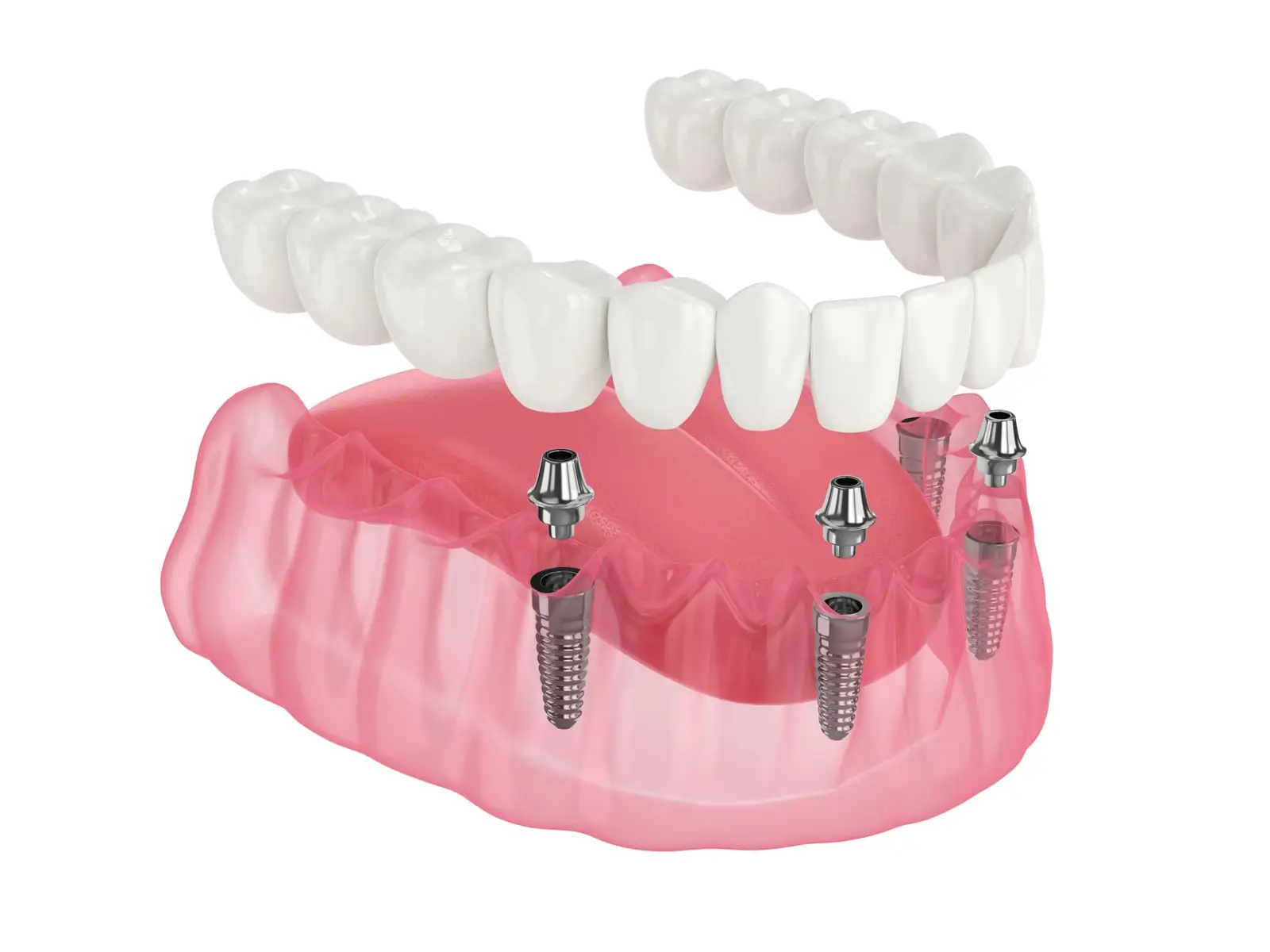
Illustration for education — not a patient case.
- Diameter
- 1.8–2.4 mm in the comparative trials, against 3.0–4.1 mm for standard-diameter implants
- Main use
- Retaining a lower complete denture; two to four implants in the front of the mandible
- Survival vs. standard
- 89–98% for minis and 99–100% for standard implants in a meta-analysis of randomized trials
- Seven-year survival
- 91.4% across 39 studies and 3,787 mini-implants; most failures occurred in the first year
- Two vs. four in the mandible
- 92.2% vs. 96.2% five-year survival — four outperformed two
- Maintenance
- Attachment wear around 19%, relining 24%, prosthesis fracture 14.5% in the same pooled review
On this page
What a mini dental implant isLink to this section: What a mini dental implant is
A mini dental implant is a narrow-diameter post. In the published trials comparing them with conventional implants, minis measured 1.8 to 2.4 mm across while standard-diameter implants measured 3.0 to 4.1 mm. Length is broadly similar — the trials list 10 to 18 mm for minis and 10 to 12 mm for standard implants.
The other structural difference matters as much as the width. Most minis are one-piece: the post and the attachment head are milled as a single unit, so there is no separate abutment and no internal connection. That simplifies the surgery and removes a component that can loosen. It also removes the flexibility to correct the angle later or to change the attachment without changing the implant.
Where minis genuinely earn their placeLink to this section: Where minis genuinely earn their place
The strongest, clearest use is stabilizing a lower denture. A conventional lower denture floats on a narrow, resorbed ridge with no suction to hold it, which is why so many long-term wearers describe a lifetime of adhesive and avoided foods. Two to four minis placed in the front of the lower jaw give that denture something to snap onto.
The evidence here is real. A ten-year observational study of one-piece minis, 1.8 mm across, retaining lower overdentures reported 100 percent implant survival across 56 implants in the patients who completed follow-up, with mean marginal bone loss of 1.12 mm over the decade and bone levels stabilizing after year five. Prosthetic survival was 93 percent. The authors concluded that one-piece minis retaining a lower implant overdenture can be considered an alternative treatment for atrophic mandibles in elderly patients.
The second reasonable use is a genuinely narrow space — a small lower incisor gap, for example, where a standard-diameter implant simply will not fit between the roots of the neighboring teeth without grafting.
Why the procedure is often shorterLink to this section: Why the procedure is often shorter
Minis need a narrower channel in the bone. In favorable cases that channel can be prepared with less drilling, sometimes without lifting a gum flap, and the implants can often be loaded straight away with an existing denture relined to snap onto them. Fewer components, fewer surgical steps, and often fewer visits.
Less bone width can also be enough. Someone told that a conventional implant plan needs bone grafting may find a mini fits the ridge as it stands. That is a real advantage, and it is the reason minis are so often discussed with long-term denture wearers whose lower ridge has resorbed. Whether it applies to you is a scan question, not a brochure question — see how much bone is needed for a dental implant.
What the long-term evidence actually showsLink to this section: What the long-term evidence actually shows
This is where balance matters. A systematic review and meta-analysis of randomized controlled trials comparing minis under 3 mm with standard-diameter implants over 3 mm for lower overdentures reported implant survival of 89 to 98 percent for minis and 99 to 100 percent for standard implants. Quality-of-life improvement was reported in all patients with no statistically significant difference between the groups, and one study found higher self-rated pain with minis a week after placement. The authors concluded minis are a feasible substitute for conventional implants when the aim is retention of a lower overdenture — while noting that follow-up in most of the included trials was only 12 months and calling for trials running at least five years.
A larger review pooled 39 studies covering 3,787 mini-implants supporting 1,026 overdentures in 1,005 patients. It reported a seven-year cumulative survival rate of 91.4 percent, with 202 failures, most occurring in the first year. Survival was lower in the upper jaw than the lower — 87.1 percent against 92.3 percent at five years — and lower for two-implant designs than four-implant designs in the mandible, 92.2 percent against 96.2 percent. Marginal bone loss climbed steadily, from about 0.5 mm within six months to roughly 1.3 mm at the longest follow-ups.
Read together, those figures say something specific: minis do well in the lower jaw, in numbers of four rather than two, holding a denture rather than a fixed bridge.
The maintenance nobody mentionsLink to this section: The maintenance nobody mentions
The same 39-study review recorded the technical complications, and they are the honest counterweight. Attachment matrix wear occurred in 19.2 percent of cases, attachment patrix wear in 19.6 percent, denture relining in 24.0 percent, and transverse fracture of the prosthesis in 14.5 percent. Overall prosthesis failure was 7.4 percent, almost all from fracture. The authors concluded that mini-implant overdentures, despite a high seven-year survival rate and acceptable bone loss, may require frequent maintenance follow-ups because of the high rate of technical complications.
In plain terms: the implants tend to stay. The denture and its attachment parts need servicing — new O-rings or housings, occasional relining, sometimes a reinforced or remade denture. Budget for that from the start rather than treating it as a surprise.
Where minis fall short of standard implantsLink to this section: Where minis fall short of standard implants
A narrow post has less surface in contact with bone and a thinner core, so it carries less load and has less margin against fracture. That is why minis are rarely the answer for a molar, for a fixed full-arch bridge, or for someone who grinds heavily. Standard-diameter implants remain the reference for load-bearing work, and the comparative trials put their survival at 99 to 100 percent against 89 to 98 percent for minis.
Being one-piece also limits the options. There is no separate abutment to swap when the gum settles, no angle correction, and if the head of the implant fractures the whole post has to come out.
Who they suit, and who they do notLink to this section: Who they suit, and who they do not
Minis suit a long-term lower denture wearer with a resorbed ridge who wants stability without grafting, a longer surgery, or a larger fee. They suit a narrow single space where a standard implant would need bone augmentation first. They suit someone whose health or age makes a shorter, less invasive appointment genuinely preferable.
They are a poorer fit for the upper jaw, where the pooled survival was lower, for heavy grinders, for back teeth carrying chewing load, and for anyone whose plan is a fixed bridge rather than a removable denture. If fixed teeth are the goal, compare full-arch dental implants and implant-supported dentures rather than starting from implant width.
Asking about minis at a consultation in Huntington BeachLink to this section: Asking about minis at a consultation in Huntington Beach
Useful questions: how many minis do you recommend and why that number; is the plan two or four in the lower jaw; will my existing denture be relined onto them or a new one made; how often will the attachments need replacing; and would a standard-diameter implant fit if we grafted first. Ask for both plans priced, not just one.
The affiliated offices in Huntington Beach and Downey list implant-supported dentures, overdentures on implants, bone grafting, and 3D imaging among their services. Beachside Dental Group publishes a free consultation including full-mouth X-rays and an examination, and a $699 dental implant placement offer covering placement, exam, and X-rays for new patients — abutment, crown, and sedation are separate, offers cannot be combined with insurance or other offers, and terms may change. Request a consultation when you want the scan to answer it.
Benefits
- Can often be placed in a narrow ridge without bone grafting first
- Fewer surgical steps and often a shorter appointment than standard-diameter placement
- An existing lower denture can frequently be relined to snap onto them
- A ten-year study of 1.8 mm minis under lower overdentures reported 100% implant survival with bone levels stabilizing after year five
- Quality-of-life gains matched standard-diameter implants in the randomized comparisons
- Generally a lower fee than an equivalent number of standard-diameter implants
Limitations & considerations
- Survival trails standard-diameter implants — 89–98% against 99–100% in the pooled randomized trials
- Most trial follow-up runs only 12 months; the authors called for studies of at least five years
- Upper-jaw survival was lower than lower-jaw survival, 87.1% against 92.3% at five years
- Attachment wear, relining, and denture fracture are common enough to plan and budget for
- One-piece design means no angle correction, no abutment swap, and removal of the whole post if the head fractures
What the process looks like
Exam, 3D scan, and denture assessment
Ridge width and height are measured, the bite is checked, and the existing denture is assessed for whether it can be relined or should be remade.
Plan and implant count agreed
Two or four in the lower jaw, positioned in the front where bone is densest, with both a mini plan and a standard-diameter plan itemized where both are possible.
Placement
Narrow channels are prepared and the one-piece implants seated under local anesthesia, often with a smaller surgical footprint than standard placement.
Denture connected
Housings are fitted into the denture so it snaps onto the implant heads, either the same day where stability allows or after a healing interval.
Healing and adjustment
The bite and fit are refined over the following weeks as the tissue settles and you adapt to the new retention.
Ongoing maintenance
Attachment inserts are replaced as they wear, the denture is relined when the ridge changes, and the implants and gums are checked at review visits.
| Feature | Mini implants | Standard-diameter implants |
|---|---|---|
| Diameter | 1.8–2.4 mm in the comparative trials. | 3.0–4.1 mm in the same trials. |
| Design | Usually one piece — post and attachment head milled together, no separate abutment. | Usually two pieces, so the abutment can be angled, swapped, or removed for servicing. |
| Bone required | Less ridge width; often placeable without grafting. | More width and height; grafting or a sinus lift may be needed first. |
| Reported survival | 89–98% in randomized comparisons; 91.4% cumulative at seven years across 39 studies. | 99–100% in the same randomized comparisons. |
| Typical use | Snapping a lower denture into place, or a genuinely narrow single space. | Single crowns, bridges, and fixed full-arch restorations carrying chewing load. |
| Surgery | Narrower channel, often fewer steps and a shorter appointment. | Fuller surgical protocol, sometimes staged with grafting. |
| Maintenance | Attachment inserts wear, dentures need relining, and prosthesis fracture is not rare. | Restoration checks and hygiene maintenance, with fewer wearing components. |
| Evidence maturity | Most randomized follow-up is 12 months; authors call for five-year trials. | Decades of long-term data across many indications. |
Is it right for you?
Mini implants suit people who want a lower denture held firmly and whose ridge is too narrow for standard implants without grafting. They are not a smaller version of every implant plan — the dentist who examines you decides from a 3D scan whether the ridge, the bite, and the goal actually match a narrow post.
Often a good fit
- A long-term lower denture wearer with a resorbed but sound ridge
- Someone who wants to avoid grafting or a longer surgical appointment
- A narrow single space where a standard implant would not fit between roots
- Willingness to attend maintenance visits for attachment and denture servicing
Worth discussing first
- Upper-jaw overdentures, where pooled survival was lower than in the mandible
- Heavy grinding or clenching, which loads a narrow post hard
- Back teeth or any fixed bridge carrying full chewing load
- Smoking, unmanaged diabetes, or untreated gum disease, which affect healing whatever the implant width
Questions people ask
What is the difference between a mini implant and a regular implant?
Width and design. In the randomized comparisons minis measured 1.8 to 2.4 mm across against 3.0 to 4.1 mm for standard implants, and minis are usually one piece with the attachment head built in. A narrower post carries less load and offers no way to change the abutment later.
Do mini implants work as well as standard implants?
For holding a lower denture, the randomized evidence says they are a feasible substitute, with quality-of-life gains matching standard implants. Survival is lower — 89 to 98 percent against 99 to 100 percent — and follow-up in most trials was only 12 months. For load-bearing fixed work they are not the equivalent.
How many mini implants do I need for a lower denture?
Two or four is the usual choice, and the numbers favor four. A pooled review of 39 studies found five-year survival in the mandible of 92.2 percent for two-implant designs and 96.2 percent for four-implant designs, a statistically significant difference. Your dentist decides from the ridge, the bite, and the denture.
Can mini implants be placed without bone grafting?
Often, which is a genuine advantage for a narrow, resorbed ridge. A narrower post needs less bone width than a standard implant. Whether your ridge qualifies is answered by a 3D scan, not by the implant type — the guide to bone grafting explains what the scan is looking for.
How long do mini dental implants last?
Nobody can promise a lifespan. A pooled review of 3,787 mini-implants reported a seven-year cumulative survival rate of 91.4 percent, with most failures in the first year, and a ten-year study of 1.8 mm minis under lower overdentures reported 100 percent implant survival with bone levels stabilizing after year five. Individual outcomes vary with bone, bite, smoking, and maintenance.
Can I use my existing denture with mini implants?
Frequently, yes — housings are fitted into the denture so it snaps onto the implant heads. Whether your denture is sound enough to convert depends on its age, fit, and thickness. The same review found transverse prosthesis fracture in 14.5 percent of cases, which is one reason a reinforced or new denture is sometimes recommended.
Are mini implants suitable for the upper jaw?
Less so. The pooled review reported five-year survival of 87.1 percent in the maxilla against 92.3 percent in the mandible, a statistically significant difference, and the maxillary evidence base was much smaller. Upper cases deserve a careful conversation about standard-diameter alternatives.
What maintenance should I expect?
Plan on it. The 39-study review recorded attachment matrix wear in 19.2 percent of cases, attachment patrix wear in 19.6 percent, denture relining in 24.0 percent, and prosthesis fracture in 14.5 percent, concluding that mini-implant overdentures may require frequent maintenance follow-ups. Ask what inserts and relines cost before you start.
Sources
- Retention of mandibular complete overdentures using mini dental implants and standard diameter implants: systematic review and meta-analysis of RCTs (PMC)
- Clinical and radiographic outcomes of mini-implant-retained maxillary and mandibular overdentures: systematic review and meta-analysis (PMC)
- One-piece mini dental implant-retained mandibular overdentures: 10-year clinical and radiological outcomes (PMC)
- Cleveland Clinic — Dental Implants
- Cleveland Clinic — Implant-Supported Dentures
- ADA MouthHealthy — Implants
This guide is general dental education and not a substitute for an examination or diagnosis. Treatment recommendations always depend on your individual evaluation at an affiliated office. How it was written and sourced: editorial policy.
Where the consultation happens
Two affiliated offices in Huntington Beach

Beachside Dental Group
Huntington Beach

Pacifica Dental
Huntington Beach
Also in the network: Marina Dentistry (Marina del Rey) and Rio Hondo Dental (Downey).
Talk through mini implants with a dentist
Request a consultation at an affiliated Huntington Beach office. You'll leave with an itemized, written plan — and no obligation to proceed.