
Single-Tooth Dental Implants
A single-tooth dental implant replaces one missing tooth with a small post in the jawbone, a connector called an abutment, and a custom crown. It is usually preferred over a bridge for one tooth because the neighboring teeth are left untouched and the bone under the gap stays in use.
By DICHB editorial teamPrepared from established dental references · clinical review by Dr. Sameer Aljanedi pendingUpdated
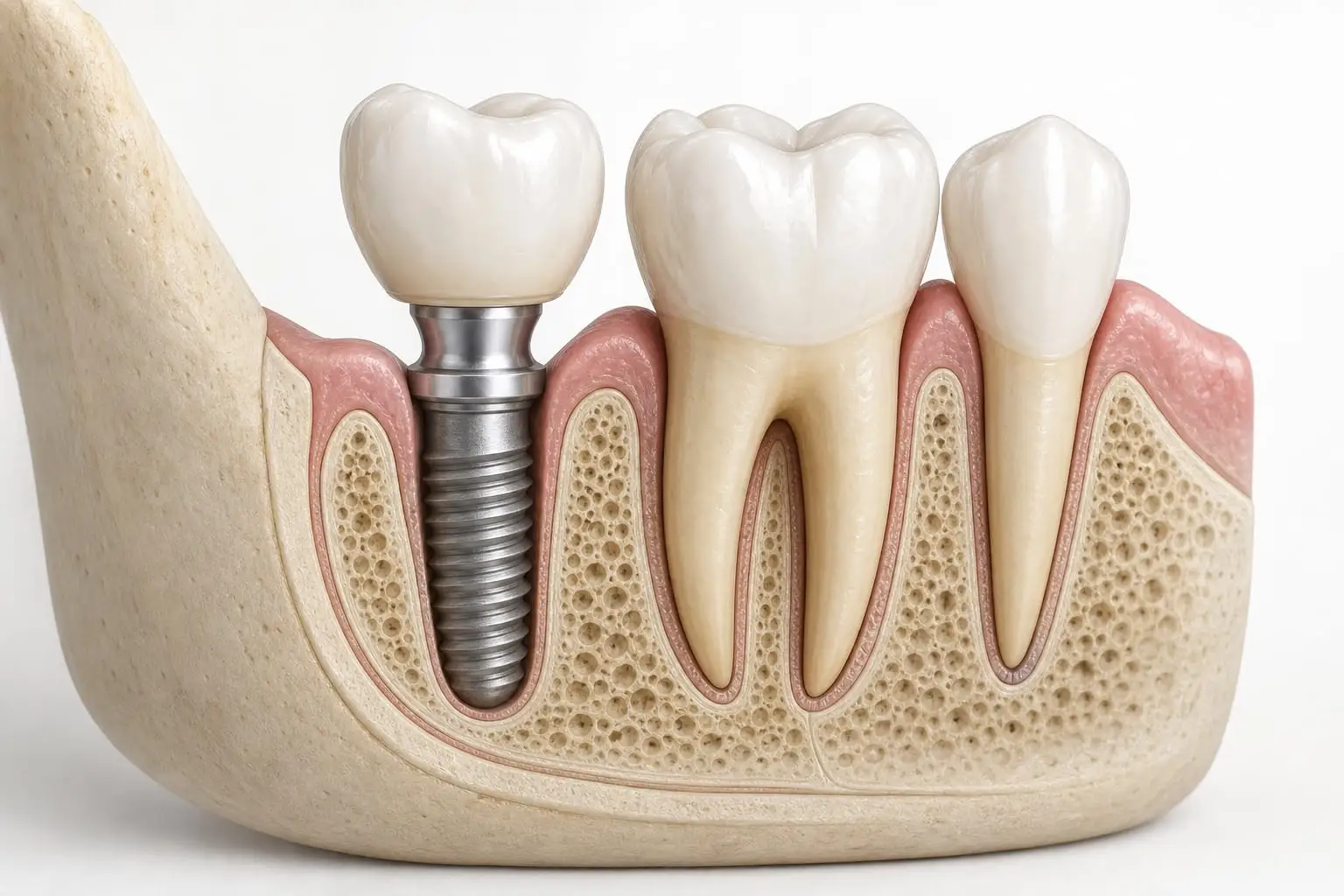
Illustration for education — not a patient case.
- Replaces
- One missing tooth, with no work on the neighboring teeth
- Parts
- Implant post, abutment, and a custom crown (Cleveland Clinic)
- Integration time
- Cleveland Clinic describes three to nine months for bone to fuse to the post
- Typical visits
- Consultation and imaging, placement, a healing check, then abutment and crown
- Longevity
- Implants can often last a lifetime with care; crowns and bridges around 15 years (Cleveland Clinic)
On this page
Illustration for education — not a patient caseThe three parts of a single-tooth implant
- Crown — The visible tooth — custom-made porcelain or zirconia, matched to its neighbors. A wear part that can be renewed years later without touching the implant.
- Abutment — The connector that joins the crown to the implant. Stock or custom-milled; custom abutments shape the gum line on front teeth.
- Implant (fixture) — The threaded titanium post placed in the jaw. Bone grows onto its surface over months — osseointegration — which is what makes it stable.
- Jawbone — Needs enough height and width to hold the implant. Where it has shrunk after tooth loss, a graft can rebuild it.
- Gum (soft tissue) — Seals around the abutment. Healthy, well-cleaned gum is the main defense against peri-implantitis, the long-term risk.
How a single-tooth implant is builtLink to this section: How a single-tooth implant is built
A single-tooth implant has three parts. Cleveland Clinic describes them as a small threaded post that takes the place of the tooth root, an abutment that connects to the post, and the restoration, which for one tooth is a single crown. The post is usually titanium, though ceramic versions exist, and it is placed in the jawbone where the missing root used to be.
Over the following months the bone heals around the post. This process is called osseointegration, and Cleveland Clinic describes it taking three to nine months. Once the implant is stable, the abutment and a custom crown are attached and the new tooth goes into function. The crown is shaped and shaded to match the teeth beside it.
Why an implant is usually preferred for one missing toothLink to this section: Why an implant is usually preferred for one missing tooth
The main alternative for a single gap is a three-unit bridge: crowns on the two neighboring teeth joined to a false tooth in the middle. To make a bridge, those neighbors are reduced so crowns can fit over them. The ADA notes that some people choose implants specifically because they do not want good tooth structure removed to make a bridge, and Cleveland Clinic makes the same point: implants do not require enamel removal the way bridges do.
There is a second reason that matters over decades. According to the AAID, dental implants are the only dental restoration option that preserves natural bone and helps stimulate bone growth. A bridge spans the gap from above while the bone beneath the missing tooth keeps shrinking. An implant loads that bone the way a root did.
Longevity favors the implant as well. Cleveland Clinic states that with good care implants can often last a lifetime, while crowns and bridges last around 15 years. The crown on top of an implant still wears and may eventually need replacing, but the post underneath typically stays. Bridges still have a place, and the fuller trade-offs are laid out in dental implants versus bridges.
Who a single implant applies toLink to this section: Who a single implant applies to
This guide fits anyone missing one tooth, or about to lose one: a cracked molar, a tooth that failed after a root canal, a front tooth lost to injury, or a tooth that never developed. It also fits people whose old bridge has failed and who would rather not re-crown the neighbors.
Cleveland Clinic lists the basics: you need to be at least 18 and done growing, with enough healthy bone in your jaw for the implant to take hold, and there is no upper age limit. The ADA adds that good general health matters more than age, and that your dentist may ask for a physician evaluation before surgery. The wider picture, including medical conditions and habits that change the plan, is in who is a candidate for dental implants.
What the treatment involvesLink to this section: What the treatment involves
Most single-tooth cases follow the three phases the ADA describes: surgical placement, bone healing, and fitting the replacement tooth. Before any of that, the dentist who examines you reviews your health history and takes imaging to measure bone height and width and to map nerves and sinuses. If the failing tooth is still present, extraction is planned first, sometimes with socket preservation, which is explained in how bone grafting supports an implant.
Placement itself is a surgical visit under local anesthesia, with sedation as an option at the affiliated offices. Cleveland Clinic outlines the steps: the gum is numbed, a small opening is made, a precise channel is prepared in the bone, the implant is placed, and the site is closed with stitches. Many patients are surprised at how short the appointment is.
Then comes healing. Depending on the site and how firmly the implant seated, you may wear a temporary tooth so there is no visible gap, which matters most for front teeth. After integration, the abutment and crown are fitted at a separate appointment that Cleveland Clinic describes as taking about an hour. The full sequence, with what happens at each visit, is in the dental implant process.
What to expect afterwardLink to this section: What to expect afterward
Cleveland Clinic says slight discomfort and swelling are normal after surgery, that over-the-counter pain relievers help, and that most people feel normal within a week or so. The ADA suggests soft foods, cold foods, and warm soup during healing. Bleeding or swelling that gets worse rather than settling is a reason to contact the treating dentist rather than wait it out. A day-by-day picture is in what dental implant recovery feels like.
The finished tooth is cleaned like a natural one: brushing, flossing around the crown, and regular check-ups. Cleveland Clinic ties the lifetime expectation for an implant directly to that routine.
Consultation in Huntington BeachLink to this section: Consultation in Huntington Beach
The affiliated offices offer a consultation at which the dentist who examines you confirms whether the site is ready, whether a graft is needed, and what a realistic timeline looks like for you. Beachside Dental Group publishes a free consultation that includes full-mouth X-rays and an examination, and a $699 dental implant placement offer that covers placement, the exam, and X-rays; the abutment, crown, and sedation are priced separately. Offers are for new patients, cannot be combined with insurance or other offers, and may change.
Because a single-tooth case is usually the simplest implant plan, it is also the one where a written, itemized estimate is easiest to give. What that visit covers is described in what a dental implant consultation involves, and the cost drivers are in what dental implants cost.
When a single implant is not the right choiceLink to this section: When a single implant is not the right choice
- The neighboring teeth already carry large fillings or old crowns and would benefit from being crowned anyway. In that case a bridge can be a reasonable, faster choice.
- Gum disease is active or untreated. Cleveland Clinic lists it among the conditions that make an implant unsuitable until it has been treated.
- Smoking or vaping, unmanaged diabetes, or severe bone loss. Cleveland Clinic notes these can disrupt healing; some are fixable before treatment, others change the plan.
- Timing or budget. A removable partial or a bonded bridge can hold the space while you plan for an implant later. Options are compared in alternatives to dental implants.
Benefits
- Neighboring teeth are not ground down, unlike a conventional bridge
- Keeps the bone under the gap in use, which the AAID says no other restoration does
- Cleaned like a natural tooth: brush and floss, no special threaders under a pontic
- The crown can be replaced later without disturbing the implant
- Often the longest-lasting option for a single gap, per Cleveland Clinic
Limitations & considerations
- It is a surgical procedure with a healing period of months before the final crown
- Costs more up front than a bridge, even though it may cost less over decades
- Not suitable while gum disease is active or if bone is too thin without grafting
- Smoking, vaping, and unmanaged diabetes can disrupt healing
What the process looks like
Consultation and 3D imaging
The dentist reviews your health history and imaging to measure bone, map nerves and sinuses, and decide whether a graft is needed.
Extraction, if the tooth is still present
A failing tooth is removed, sometimes with a socket graft to preserve the ridge for the implant.
Implant placement
Under local anesthesia, with sedation available, the post is placed in the jaw and the gum is closed with stitches.
Healing and integration
Bone fuses to the post over a period Cleveland Clinic describes as three to nine months. A temporary tooth can fill the gap if needed.
Abutment and crown
The connector and custom crown are fitted at a visit Cleveland Clinic describes as about an hour, then the bite is checked.
| Feature | Single-tooth implant | Three-unit bridge |
|---|---|---|
| Neighboring teeth | Untouched | Reduced and crowned to carry the bridge |
| Bone under the gap | Kept in use by the implant (AAID) | Continues to shrink beneath the false tooth |
| Surgery | Yes, with months of healing | None; two to three visits |
| Cleaning | Brush and floss like a natural tooth | Floss threaders or water flosser under the pontic |
| Expected lifespan | Implant can often last a lifetime (Cleveland Clinic) | Around 15 years (Cleveland Clinic) |
| Up-front cost | Higher | Usually lower initially |
Is it right for you?
Most adults missing a single tooth can be considered, provided the gums are healthy and there is enough bone at the site. The dentist who examines you will confirm candidacy from your history and 3D imaging.
Often a good fit
- Adults who are done growing with healthy, well-maintained gums
- A single gap where the neighboring teeth are sound
- Enough bone at the site, or a site that can be grafted
- Willingness to keep up brushing, flossing, and check-ups
Worth discussing first
- Active or untreated gum disease
- Smoking or vaping, which Cleveland Clinic says can disrupt healing
- Unmanaged diabetes or conditions that affect bone healing
- Heavy clenching or grinding without a protective guard
Questions people ask
How long does a single-tooth implant take from start to finish?
It depends on whether an extraction or graft comes first. Cleveland Clinic describes the bone-fusion phase alone taking three to nine months, so most single-tooth cases span several months from placement to the final crown. The dentist who examines you will give a timeline for your site.
Will I have a gap while the implant heals?
Not necessarily. A temporary tooth can be made so the space is not visible, particularly for a front tooth. Your dentist will advise whether a temporary attached to the implant itself is reasonable in your case.
Does getting a single implant hurt?
The surgery is done under local anesthesia, and sedation is available at the affiliated offices. Afterward, Cleveland Clinic says slight discomfort and swelling are normal and that over-the-counter pain relievers help, with most people feeling normal within a week or so.
Why not just get a bridge? It is faster.
A bridge is faster and avoids surgery, but it requires reducing the two neighboring teeth, and the bone under the gap keeps shrinking. An implant leaves the neighbors alone and keeps the bone in use. If the neighbors already need crowns, a bridge can still be a sensible choice.
Can a front tooth be replaced with an implant?
Yes, and it is one of the most common requests. Front teeth demand more attention to gum shape and crown color, and a temporary is usually planned so nothing is visible during healing.
How do I care for a single implant?
Brush and floss around the crown like a natural tooth and keep regular check-ups. Cleveland Clinic links that routine to implants often lasting a lifetime.
What does the Beachside $699 offer include?
It covers implant placement with the exam and X-rays for new patients. The abutment, crown, and sedation are separate, it cannot be combined with insurance or other offers, and it may change. Ask for an itemized plan at your consultation.
Sources
This guide is general dental education and not a substitute for an examination or diagnosis. Treatment recommendations always depend on your individual evaluation at an affiliated office. How it was written and sourced: editorial policy.
Where the consultation happens
Two affiliated offices in Huntington Beach
Beachside Dental Group
Huntington Beach
Pacifica Dental
Huntington Beach
Also in the network: Marina Dentistry (Marina del Rey) and Rio Hondo Dental (Downey).
Talk through single-tooth implants with a dentist
Request a consultation at an affiliated Huntington Beach office. You'll leave with an itemized, written plan — and no obligation to proceed.