
Bone Grafting for Dental Implants
Bone grafting rebuilds jawbone that has shrunk after tooth loss so an implant has enough support. It ranges from a small socket graft at extraction to ridge augmentation or a sinus lift, heals over months before the implant is placed, and is often avoidable when an implant is planned early.
By DICHB editorial teamPrepared from established dental references · clinical review by Dr. Sameer Aljanedi pendingUpdated
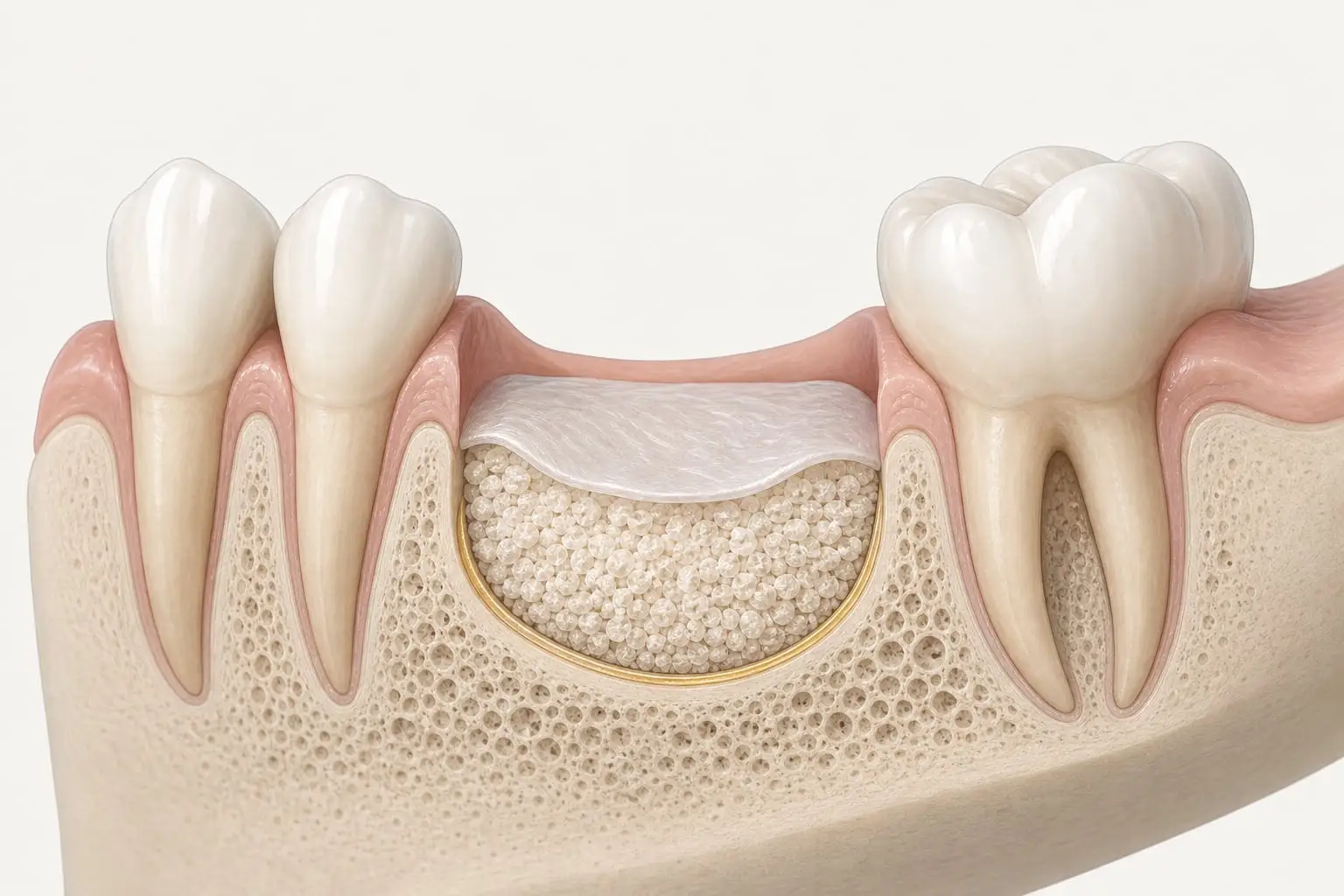
Illustration for education — not a patient case.
- Purpose
- Rebuild jawbone so an implant has enough support (Cleveland Clinic)
- Main procedures
- Socket preservation, ridge augmentation, sinus lift
- Material sources
- Autograft, allograft, xenograft, synthetic
- Healing
- Months, set by graft type and size; the implant then integrates over three to nine months per Cleveland Clinic
- Extra surgery
- The AAOMS notes grafting requires another surgery but creates a stable base for implants
On this page
Why bone shrinks after a tooth is lostLink to this section: Why bone shrinks after a tooth is lost
Jawbone stays dense because tooth roots load it every time you chew. When a tooth is removed that stimulus stops, and the bone around the empty socket begins to shrink in both height and width. The AAID makes the point that dental implants are the only dental restoration option that preserves natural bone, precisely because an implant restores that loading; bridges and dentures do not.
The longer a site sits empty, and the more teeth that are missing, the more bone is lost. That is why someone who lost a tooth years ago, or who has worn a denture for a long time, is more likely to hear that grafting is needed. Cleveland Clinic states that with all types of implants there must be enough jawbone to support them, and if there is not, bone grafts may be needed to build up the areas of loss.
The main types of graftLink to this section: The main types of graft
Socket preservation is the smallest procedure. At the time of extraction, graft material is packed into the empty socket and covered with a membrane so the ridge keeps most of its shape while it heals. It is done to avoid a larger graft later, and it is the reason many dentists prefer to plan the implant before the tooth is removed.
Ridge augmentation rebuilds a ridge that has already shrunk. Material is placed on the thin area, covered with a membrane, and left to mature before the implant is placed; for larger defects a block of bone or a titanium mesh may be used to hold the shape.
A sinus lift is specific to the upper back jaw, where the floor of the sinus can sit close to the ridge after molars are lost. The sinus membrane is gently raised and graft material is placed beneath it to create enough height for an implant. Depending on how much height is needed, it may be done at the same visit as implant placement or as a separate stage.
Graft materialsLink to this section: Graft materials
Graft material comes from four sources, and the dentist chooses by the size of the defect, the healing expected, and your preference.
- Autograft: your own bone, taken from another site in the mouth. It is the only living graft and needs a second surgical site.
- Allograft: processed donor bone from a tissue bank.
- Xenograft: processed bone mineral of animal origin, commonly bovine.
- Synthetic (alloplast): manufactured materials that act as a scaffold for your own bone to grow into.
Each is used routinely, and none is right for every case. If a particular source matters to you for medical, religious, or personal reasons, say so at the consultation so the plan can be built around it.
Who grafting applies toLink to this section: Who grafting applies to
Grafting is discussed when the scan shows the ridge is too thin or short for the planned implant, when a tooth is being extracted and an implant is planned for the site later, when the sinus sits low in the upper back jaw, or when a full-arch case needs more bone in a specific area. It is not a sign that implants are off the table. The AAOMS notes that bone grafting creates a stable base for implants and helps improve long-term treatment success, while also pointing out that it requires another surgery.
Healing rules still apply. Cleveland Clinic lists smoking or vaping, unmanaged diabetes, and active gum disease as problems for healing, and grafts are at least as sensitive to them as implants. See who is a candidate for dental implants and how much bone an implant needs.
What the procedure involvesLink to this section: What the procedure involves
Most grafts are done under local anesthesia, with sedation available at the affiliated offices. The gum is opened, the material is placed and shaped, a membrane is laid over it, and the site is stitched closed. Socket preservation adds only minutes to an extraction; ridge augmentation and sinus lifts are longer appointments.
Healing time depends on the type and size of graft, and the dentist who treats you sets the interval before the implant can go in. A socket graft generally matures sooner than a large ridge or sinus graft. Once the implant is placed, Cleveland Clinic describes its own integration taking three to nine months, so a grafted case is a staged plan with two healing periods. The overall sequence is in the dental implant process.
What to expect afterwardLink to this section: What to expect afterward
Swelling and bruising are common after grafting, especially with a sinus lift, and a soft diet for a stretch protects the site. Cleveland Clinic describes discomfort and swelling after implant surgery as normal and manageable with over-the-counter relief, and the same applies here. After a sinus lift you will be asked not to blow your nose forcefully or sneeze with your mouth closed for a period.
Swelling or bleeding that worsens rather than settles, or graft particles coming loose, should be reported to the treating dentist. The first weeks are described in what dental implant recovery feels like.
When grafting can be avoidedLink to this section: When grafting can be avoided
Not every thin ridge needs a graft. Placing the implant soon after extraction, before much bone is lost, often avoids one; the timing question is covered in how long after an extraction an implant can be placed. Angled implants in full-arch designs can engage denser bone away from thin areas, and shorter or narrower implants suit some sites.
Choosing an overdenture on fewer implants, placed where bone is thickest, can sidestep grafting that a fixed bridge would require; see implant-supported dentures. The decision is always made from the scan, not from a rule of thumb.
Consultation in Huntington BeachLink to this section: Consultation in Huntington Beach
Whether you need a graft is a 3D-scan question, and the affiliated offices in Huntington Beach and Downey list bone grafting and 3D imaging among their services. Beachside Dental Group publishes a free consultation including full-mouth X-rays and an examination; its $699 dental implant placement offer covers placement, exam, and X-rays for new patients, with grafting, the abutment, crown, and sedation priced separately, and may change.
Grafting is one of the largest sources of price variation between two implant cases, so ask for it as its own line on the written, itemized plan. See dental implant cost.
When grafting is not the right choiceLink to this section: When grafting is not the right choice
- The site can take an implant without it. Grafting is a means to an implant, not a goal in itself.
- A bridge or partial denture is the plan and no implant is intended; see dental implant alternatives.
- Healing is compromised by smoking, unmanaged diabetes, or active gum disease that has not been treated.
- A large graft plus implants is more surgery than you want. Say so; a removable option may fit better.
Benefits
- Makes an implant possible at a site that would otherwise be too thin
- Socket preservation at extraction can avoid a larger graft later
- A sinus lift opens the upper back jaw to implants after molar loss
- Four material sources let the plan match your preferences
- Improves the support an implant rests on over the long term, per the AAOMS
Limitations & considerations
- It is an additional surgery with its own healing period before the implant
- Adds months to the overall timeline and a line to the cost
- Large ridge and sinus grafts carry more swelling than socket grafts
- Smoking, unmanaged diabetes, and gum disease compromise graft healing
What the process looks like
Consultation and 3D scan
Bone height and width are measured and the sinus and nerve mapped to decide whether a graft is needed and which type.
Material choice
Autograft, allograft, xenograft, or synthetic is chosen for the defect size and your preference.
Graft placement
Under local anesthesia with sedation available, the site is opened, material placed and shaped, a membrane laid over it, and the gum closed.
Graft healing
The graft matures over months; the interval is set by the treating dentist based on graft type and size.
Implant placement and integration
The implant is placed in the rebuilt bone and integrates over a period Cleveland Clinic describes as three to nine months.
| Feature | Socket preservation | Ridge augmentation / sinus lift |
|---|---|---|
| When it is done | At the time of extraction | After bone has already been lost |
| Goal | Keep the ridge from shrinking | Rebuild height or width that is gone |
| Scale | Small; adds minutes to an extraction | Larger; a separate, longer appointment |
| Healing before the implant | Generally shorter | Generally longer, set by graft size |
| Swelling | Mild | More, especially after a sinus lift |
| Cost | Lower | Higher |
Is it right for you?
Grafting is considered when a 3D scan shows too little bone for the planned implant, when a tooth is being extracted ahead of an implant, or when the sinus sits low. Healing must not be compromised, and the dentist who examines you will say which graft, if any, fits your case.
Often a good fit
- A ridge that has thinned after years without a tooth
- A tooth about to be extracted with an implant planned for the site
- Upper molar sites where the sinus sits close to the ridge
- Well-managed general health and no tobacco use
Worth discussing first
- Smoking or vaping, which Cleveland Clinic says can disrupt healing
- Unmanaged diabetes or conditions affecting bone healing
- Active gum disease that has not been treated
- Chronic sinus disease, which complicates a sinus lift
Questions people ask
Does everyone need a bone graft before an implant?
No. Cleveland Clinic says a graft may be needed if there is not enough jawbone to support the implant. Many sites have enough, and placing the implant soon after extraction often avoids grafting altogether.
How long does a bone graft take to heal?
It depends on the type and size of graft, and the treating dentist sets the interval. A socket graft generally matures sooner than a large ridge or sinus graft. The implant itself then integrates over three to nine months, per Cleveland Clinic.
Where does the graft material come from?
Your own bone (autograft), processed donor bone (allograft), processed animal bone mineral (xenograft), or a synthetic material. All are used routinely, and you can express a preference at the consultation.
What is a sinus lift?
A graft for the upper back jaw, where the sinus floor sits close to the ridge after molar loss. The sinus membrane is raised and graft material placed beneath it to create enough height for an implant.
Is a bone graft painful?
It is done under local anesthesia with sedation available. Afterward, swelling and bruising are common and Cleveland Clinic describes post-surgical discomfort as manageable with over-the-counter pain relievers. Worsening swelling or bleeding should be reported to the treating dentist.
Can I get implants without a graft if I was told my bone is thin?
Sometimes. Angled implants, shorter implants, or an overdenture on fewer implants placed where bone is thickest can avoid grafting in some cases. A 3D scan at one of the affiliated offices is the way to find out.
Does smoking affect a bone graft?
Cleveland Clinic lists smoking or vaping among the things that can disrupt implant healing, and grafts are at least as sensitive. Dentists typically ask patients to stop before and after the procedure.
Sources
This guide is general dental education and not a substitute for an examination or diagnosis. Treatment recommendations always depend on your individual evaluation at an affiliated office. How it was written and sourced: editorial policy.
Where the consultation happens
Two affiliated offices in Huntington Beach
Beachside Dental Group
Huntington Beach
Pacifica Dental
Huntington Beach
Also in the network: Marina Dentistry (Marina del Rey) and Rio Hondo Dental (Downey).
Talk through bone grafting with a dentist
Request a consultation at an affiliated Huntington Beach office. You'll leave with an itemized, written plan — and no obligation to proceed.