
Front Tooth Implants
A front tooth implant is judged on how it looks, not just whether it integrates. The bone in front of an upper incisor root is often paper-thin, the gum can recede after placement, and the new tooth has to match a natural neighbor you see every day. Planning, timing, and a provisional tooth do most of the work.
By DICHB editorial teamPrepared from established dental references · clinical review by Dr. Sameer Aljanedi pendingUpdated
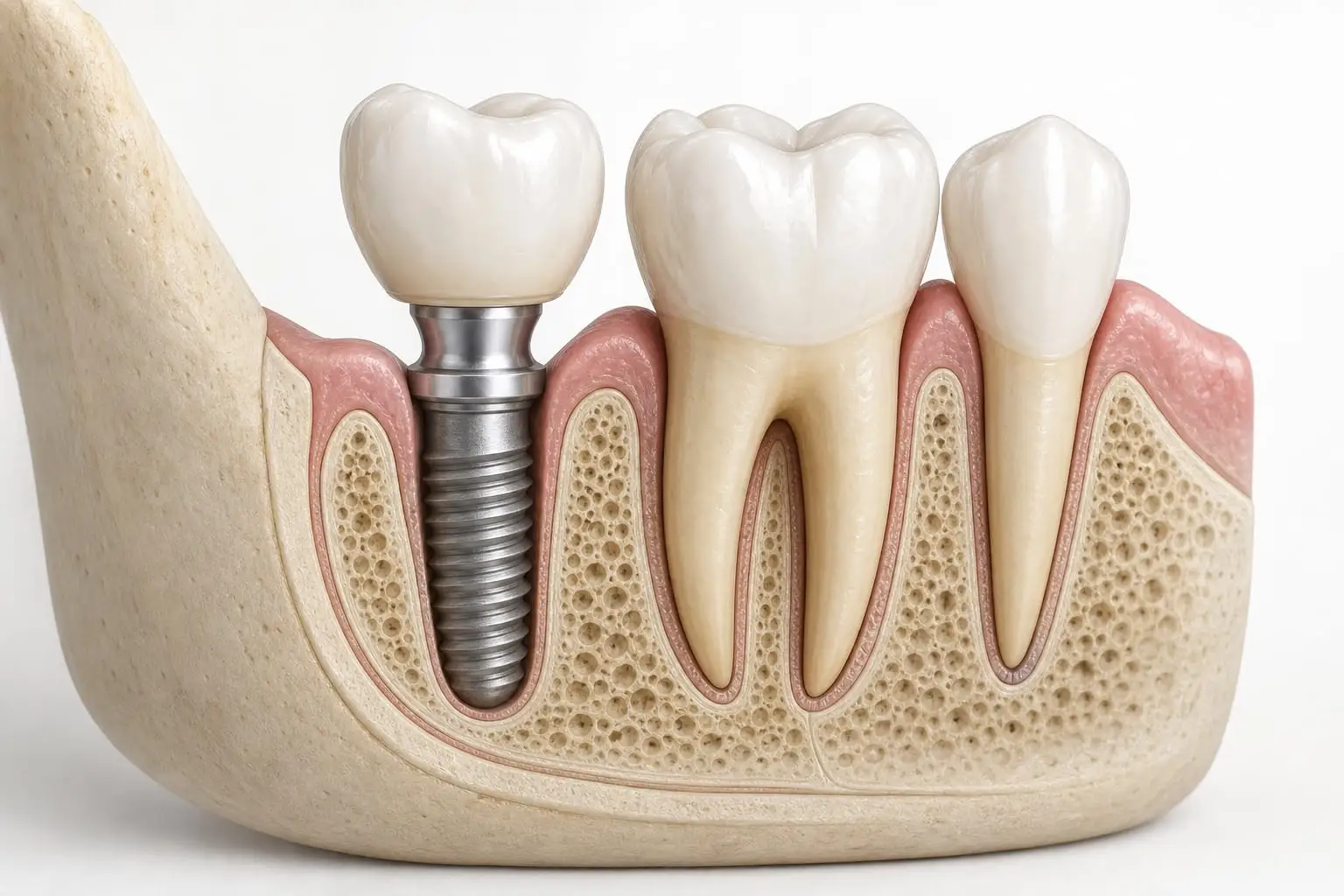
Illustration for education — not a patient case.
- Recession risk
- Midfacial recession over 1 mm in 9–41% of sites, median 26%, one to three years after immediate placement (eight studies)
- Missing facial bone
- Facial bone wall undetectable on CBCT in 36% and 57% of immediately placed sites in two retrospective studies
- Early placement
- No sites with recession over 1 mm in the two early-placement studies reviewed
- Provisional teeth
- Immediate provisionalization improved pink esthetic score by 1.54 and reduced distal papillary recession by 0.32 mm
- Integration time
- Three to nine months per Cleveland Clinic before the definitive crown
- Bonded bridge lifespan
- Cleveland Clinic puts average dental bridge lifespan at five to 15 years, longer with care
On this page
Why a front tooth is the hardest single implantLink to this section: Why a front tooth is the hardest single implant
At a molar, success is mostly biological: the implant integrates, the crown chews, nobody sees it. At an upper central incisor, a perfectly integrated implant can still disappoint if the gum sits a millimeter higher than the tooth beside it, or if the crown reads slightly too opaque in daylight.
Everything about the front of the mouth raises the difficulty: thinner bone, a more visible gum, a twin next door for comparison, and a margin for error measured in fractions of a millimeter. None of that means it cannot be done well — the planning is simply longer and the sequence matters more than at any other site.
The thin plate of bone in front of the rootLink to this section: The thin plate of bone in front of the root
The facial bone covering an upper incisor root is frequently less than a millimeter thick, and much of it depends on the tooth being there. Once the tooth is removed, that thin plate remodels and shrinks — which is why an old front-tooth gap so often looks hollowed out from the side.
The review evidence bears this out. A systematic review of esthetic outcomes following immediate and early implant placement in the anterior maxilla noted that in two retrospective studies of immediate placement with bone grafting, the facial bone wall was not detectable on cone-beam CT in 36 percent and 57 percent of sites, and that those sites showed more recession of the midfacial gum than sites where facial bone was still detectable.
That is why a cone-beam scan is not optional here: it measures the plate before anything is decided. Where it is missing or too thin, grafting belongs in the plan rather than as an afterthought — see bone grafting for dental implants.
Recession: the risk you should hear aboutLink to this section: Recession: the risk you should hear about
The most useful number to know before a front-tooth implant concerns the gum, not the implant. The same systematic review reported that immediate placement — putting the implant in at the visit the tooth comes out — carried a higher frequency of midfacial gum recession greater than 1 mm: 9 to 41 percent of sites across eight studies, median 26 percent, one to three years after placement.
For comparison, the review found no sites with recession greater than 1 mm in the two studies of early placement, where the implant goes in after the soft tissue has healed, and reported that above 90 percent of augmented early-placement sites showed visible facial bone on imaging.
The risk factors the review identifies are consistent: a thin facial bone plate, a plate that is not intact, an implant positioned too far forward, and thin gum tissue. They are anatomical and surgical variables, which is why the plan should name them.
The papilla between the teethLink to this section: The papilla between the teeth
The small triangle of gum between two teeth is called the papilla, and it is the detail that separates a good front-tooth implant from an obvious one. A missing papilla leaves a dark triangle at the gum line that no amount of crown shaping fully hides.
Papilla height depends largely on the bone level of the neighboring natural teeth, not on the implant. If the tooth next door has lost bone to gum disease, the papilla beside your new implant will sit lower, and no technique restores it reliably. It is an honest limit of the procedure, and a reason gum health is treated before implant surgery rather than after.
Timing after extractionLink to this section: Timing after extraction
There are three broad timings, each trading one risk for another. Immediate placement puts the implant in at the extraction visit — fewer surgeries, but the higher recession frequency the review describes. Early placement waits roughly four to eight weeks for the gum to close over the socket, giving more soft tissue to work with and, in the review, better midfacial outcomes. Delayed placement waits months for the socket to fill with bone: most predictable biologically, but the most ridge shrinkage to rebuild.
There is no single right answer; the choice is site-specific. What matters is that your dentist explains which is planned for you and why — the general version of that decision is covered in how long after an extraction an implant can be placed.
Provisional teeth are effectively mandatoryLink to this section: Provisional teeth are effectively mandatory
Nobody walks around with a visible gap for three to nine months while an implant integrates, so a temporary tooth is part of every front-tooth plan. It does more than fill space: a well-shaped provisional guides the gum into the contour the final crown will need.
A meta-analysis of nine studies covering 404 patients and 435 implants compared immediate provisionalization with delayed restoration in immediately placed implants. It reported significantly better pink esthetic scores with immediate provisionalization, a mean difference of 1.54, and significantly less distal papillary recession, a mean difference of 0.32 mm. Midfacial recession also favored it by 0.47 mm, though that difference did not reach statistical significance.
Whether the provisional is fixed to the implant or worn as a removable temporary depends on how firmly the implant seats at placement — the stability question covered in same-day dental implants.
Custom abutments, shade, and translucencyLink to this section: Custom abutments, shade, and translucency
The abutment connects implant to crown, and at the front it usually needs to be custom-made. A stock abutment is a generic shape; a custom one is contoured to your gum and can be shaded so nothing gray or dark reads through thin tissue. Ceramic and zirconia abutments exist for the same reason.
The crown itself is a shade-matching exercise more than a manufacturing one. A natural incisor is not one color: more translucent at the edge, warmer near the gum, often finely characterized. Matching one crown to one natural neighbor is harder than matching a pair, which is why front cases often involve a shade appointment with the ceramist, photographs, and a try-in before anything is fitted. Material choice matters here too — see titanium vs. zirconia dental implants.
When a bonded bridge is the better answerLink to this section: When a bonded bridge is the better answer
An implant is not automatically the right choice at the front. Two situations make a resin-bonded bridge worth serious consideration. The first is a young patient: jaws keep changing and an implant does not move with them, so a bonded bridge is often used as a long-term interim while growth finishes. The second is a site where the bone or gum architecture cannot support a good aesthetic result without extensive grafting the patient does not want.
Cleveland Clinic describes a Maryland bridge as using metal wings instead of crowns, typically to replace front teeth, and notes these appliances are not strong enough for back-tooth chewing forces. It puts the average lifespan of a dental bridge at five to 15 years, longer with proper care. A conventional bridge, by contrast, requires crowning healthy neighbors on both sides of the gap — a large price when those teeth are untouched. Both are compared in dental implants vs. bridges.
Asking the right questions in Huntington BeachLink to this section: Asking the right questions in Huntington Beach
Bring specifics: how thick is my facial bone on the scan, is grafting planned, when will the implant be placed relative to the extraction, will my provisional be fixed or removable, will the abutment be custom, and how will the shade be matched. Ask to see the plan for the gum, not just the implant.
The affiliated offices in Huntington Beach and Downey list single implants, bone grafting, 3D imaging, and sedation among their services. Beachside Dental Group publishes a free consultation including full-mouth X-rays and an examination, and a $699 dental implant placement offer covering placement, exam, and X-rays for new patients — the abutment, crown, and sedation are separate, offers cannot be combined with insurance or other offers, and terms may change. Request a consultation and ask for the aesthetic plan in writing.
Benefits
- Replaces the tooth without cutting down healthy neighbors, unlike a conventional bridge
- Preserves bone under the restoration rather than resting on the ridge
- A custom abutment lets the gum contour and emergence be shaped to match the natural side
- A well-shaped provisional guides the gum before the final crown is made
- Fixed and independent — it is cleaned like a natural tooth rather than threaded under
- Immediate provisionalization measurably improved gum aesthetics in the pooled evidence
Limitations & considerations
- Midfacial gum recession after immediate placement is common enough that it must be discussed beforehand
- Papilla height depends on bone on the neighboring natural teeth and cannot be reliably rebuilt
- Thin or missing facial bone often means grafting, which adds months and cost
- Matching a single crown to one natural neighbor is harder than matching a pair, and may need remakes
- A front implant almost always needs a provisional tooth throughout healing, which is a separate item
What the process looks like
Cone-beam scan, photographs, and smile assessment
Facial bone thickness, gum biotype, smile line, and the bone level on adjacent teeth are recorded before any timing decision is made.
Extraction and timing decision
The tooth is removed atraumatically where possible, and the implant is placed immediately, early after soft tissue healing, or later — with grafting where the facial plate is thin or missing.
Implant placement
Positioned deliberately toward the palatal side and at the planned depth, since a facially placed implant is one of the recognized recession risk factors.
Provisional tooth
A fixed provisional on the implant where stability allows, otherwise a removable temporary, shaped to guide the gum contour during healing.
Integration and soft tissue shaping
Months of healing over Cleveland Clinic's three-to-nine-month range, with the provisional adjusted as the gum settles into its final contour.
Custom abutment and definitive crown
The gum contour is scanned, a custom abutment made, and the crown shade matched to the neighboring tooth with photographs and a try-in before final fitting.
| Feature | Front tooth implant | Resin-bonded bridge | Conventional bridge |
|---|---|---|---|
| Neighboring teeth | Untouched — the implant stands alone. | Barely touched; Cleveland Clinic describes metal wings bonded behind them instead of crowns. | Both neighbors are prepared and crowned, even if they are healthy. |
| Surgery | Yes — placement, often with grafting. | None. | None. |
| Timeline | Months. Cleveland Clinic puts osseointegration at three to nine months before the final crown. | Two visits in most cases. | Two to three visits in most cases. |
| Bone under the gap | Loaded and maintained by the implant. | Not loaded; the ridge continues to resorb beneath the pontic. | Not loaded; the ridge continues to resorb beneath the pontic. |
| Main aesthetic risk | Midfacial recession — over 1 mm in 9–41% of immediately placed sites, median 26%. | Debonding, and the wing sometimes shadowing the backing tooth. | The gum margin around three units aging at different rates. |
| Where it fits best | Adequate facial bone, healthy neighbors, growth complete. | Young patients still growing, or sites where grafting is declined. | Neighbors that already need crowns or have large existing restorations. |
| Longevity | No lifespan can be promised; depends on gum health, bone, bite, and maintenance. | Cleveland Clinic gives an average bridge lifespan of five to 15 years, longer with care. | Same average range, with all three units at risk if one anchor fails. |
| Back teeth | Suitable. | Not suitable — Cleveland Clinic notes these are not strong enough for back-tooth chewing forces. | Suitable. |
Is it right for you?
A front tooth implant suits someone with healthy gums, enough facial bone or willingness to graft, and realistic expectations about how closely one crown can match a natural neighbor. The dentist who examines you decides the timing and the need for grafting from a cone-beam scan and a look at the gum line you show when you smile.
Often a good fit
- Healthy gums and stable bone levels on the adjacent natural teeth
- Adequate facial bone thickness on the scan, or acceptance of grafting
- A thicker gum biotype, which is less prone to midfacial recession
- Willingness to wear a provisional and attend the extra planning visits
Worth discussing first
- A thin gum biotype with a thin or missing facial bone plate
- Active gum disease or bone loss on the neighboring teeth, which limits papilla height
- A high smile line that exposes the full gum margin, raising the aesthetic demand
- Growth not yet complete, where a bonded bridge is often the better interim answer
Questions people ask
Will a front tooth implant look exactly like my other teeth?
A well-planned one can look very close, but no dentist should promise an exact match. A single crown next to one natural neighbor is the hardest match in dentistry because translucency, warmth near the gum, and fine characterization all have to be reproduced. Photographs, a shade appointment, and a try-in are how good results are achieved.
Will my gum recede around a front implant?
It can, and you should hear the numbers before you decide. A systematic review of anterior implants found midfacial recession greater than 1 mm in 9 to 41 percent of immediately placed sites across eight studies, with a median of 26 percent, one to three years after placement. Thin facial bone, thin gum tissue, and an implant positioned too far forward are the recognized risk factors.
Can the implant go in the same day the tooth is removed?
Sometimes, but at the front it is a considered decision rather than a default. The same review found early placement, after the soft tissue heals, produced no sites with recession over 1 mm in the two studies examined, while immediate placement carried the higher recession frequency. Your scan and gum biotype decide which is appropriate.
What is the papilla and why does it matter?
It is the small triangle of gum between two teeth. Its height is governed mainly by the bone level on the adjacent natural teeth rather than by the implant, so gum disease next door limits what can be achieved. When it is missing, a dark triangle shows at the gum line, and no technique restores it reliably.
Will I have a gap while the implant heals?
No. A provisional tooth is part of every front-tooth plan, either fixed to the implant where stability allows or worn as a removable temporary. It also shapes the gum: a meta-analysis of nine studies found immediate provisionalization improved pink esthetic scores by a mean difference of 1.54 and reduced distal papillary recession by 0.32 mm.
Do I need a custom abutment?
At the front, usually yes. A stock abutment is a generic shape, while a custom abutment is contoured to your gum and can be shaded so nothing dark reads through thin tissue. Ceramic and zirconia abutments serve the same purpose. It is an extra item on the quote and worth asking about specifically.
When is a bonded bridge a better choice than an implant?
Two situations stand out: a patient whose jaw is still growing, since an implant will not move with it, and a site where an aesthetic result would need extensive grafting the patient does not want. Cleveland Clinic describes Maryland bridges as bonded with metal wings, typically for front teeth, and not strong enough for back-tooth chewing forces.
Is a front tooth implant more expensive than a back one?
Usually, and the difference is rarely the implant. Grafting, a provisional worn throughout healing, a custom abutment, and additional shade-matching and laboratory time are what raise the total. Ask for those itemized rather than accepting a single figure.
Sources
- Esthetic outcomes following immediate and early implant placement in the anterior maxilla: systematic review (NCBI Bookshelf, DARE)
- Soft tissue esthetic outcome with and without immediate provisionalization in immediate implants: systematic review and meta-analysis (PMC)
- Cleveland Clinic — Dental Implants
- Cleveland Clinic — Dental Bridges
- Clinical effectiveness of zirconia versus titanium dental implants in the anterior region: an overview of systematic reviews (PMC)
- ADA MouthHealthy — Implants
This guide is general dental education and not a substitute for an examination or diagnosis. Treatment recommendations always depend on your individual evaluation at an affiliated office. How it was written and sourced: editorial policy.
Where the consultation happens
Two affiliated offices in Huntington Beach
Beachside Dental Group
Huntington Beach
Pacifica Dental
Huntington Beach
Also in the network: Marina Dentistry (Marina del Rey) and Rio Hondo Dental (Downey).
Talk through front tooth implants with a dentist
Request a consultation at an affiliated Huntington Beach office. You'll leave with an itemized, written plan — and no obligation to proceed.