
Multiple-Tooth Dental Implants & Implant Bridges
Multiple-tooth dental implants replace two or more missing teeth in a row with an implant-supported bridge: a few implants carry several connected teeth, often two implants for three teeth. It is a fixed alternative to a partial denture and leaves the natural teeth at either end untouched.
By DICHB editorial teamPrepared from established dental references · clinical review by Dr. Sameer Aljanedi pendingUpdated
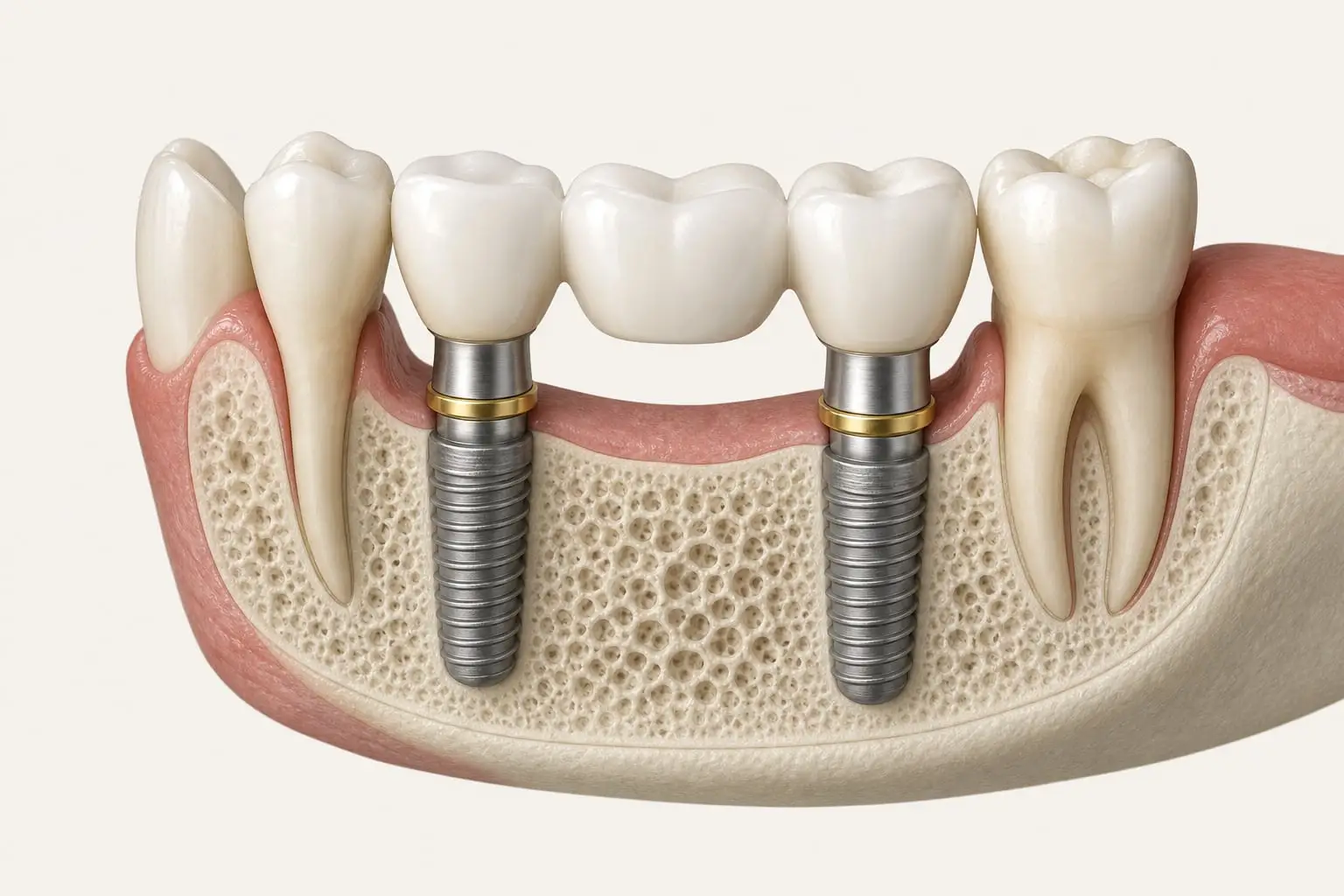
Illustration for education — not a patient case.
- Replaces
- Two or more missing teeth in a row
- Common layout
- Two implants carrying a three-tooth bridge; longer spans use more implants
- Implant count
- Cleveland Clinic describes an implant bridge as two or more implants supporting three or more teeth
- Integration time
- Three to nine months for bone to fuse, per Cleveland Clinic
- Fixed or removable
- Fixed; only the dentist removes it
On this page
What an implant-supported bridge isLink to this section: What an implant-supported bridge is
When several teeth in a row are missing, you do not need one implant per tooth. Cleveland Clinic describes an implant bridge as two or more implants that support a bridge replacing three or more teeth. The implants act as the anchors, and the bridge, a row of connected crowns, is screwed or cemented onto them.
The layout depends on how many teeth are missing and where. A three-tooth gap is often restored with two implants and a three-unit bridge: one implant at each end with a suspended tooth between them. Longer gaps use more implants, and back-of-the-mouth gaps, which take more chewing force, may need an implant under more of the teeth. The dentist who examines you decides the count from bone quality, bite, and the span to be carried.
Why implants rather than a partial denture or a tooth-supported bridgeLink to this section: Why implants rather than a partial denture or a tooth-supported bridge
The traditional fixed option for a long gap is a bridge carried on natural teeth at either end. Those teeth are reduced to accept crowns and then carry the chewing load of every missing tooth between them. The ADA notes that some people choose implants because they do not want good tooth structure removed to make a bridge, and Cleveland Clinic confirms implants do not require enamel removal the way bridges do. The longer the span, the heavier that burden on the end teeth.
The traditional removable option is a partial denture: replacement teeth on a plate or metal frame with clasps that grip the remaining teeth. It is the least invasive and least costly route, but it is removable, the clasps can wear the teeth they hold, and it rests on gum rather than bone. The ADA lists dentures that are uncomfortable among the reasons people look into implants.
Under either traditional option the bone beneath the missing teeth keeps shrinking. According to the AAID, dental implants are the only dental restoration option that preserves natural bone and helps stimulate bone growth. With a long gap that difference shows in the face and the fit of anything worn over time.
Who multiple-tooth implants apply toLink to this section: Who multiple-tooth implants apply to
The typical case is two, three, or four neighboring teeth lost to decay, gum disease, fracture, or injury, or a row of teeth that are all failing together. It also fits people with a worn partial denture who want something fixed, and people whose tooth-supported bridge has failed because an anchor tooth gave out.
Candidacy follows the same rules as any implant. Cleveland Clinic requires being at least 18 with enough healthy bone for the implants to take hold, and it lists active gum disease, unmanaged diabetes, severe bone loss, and smoking or vaping as problems for healing. Long gaps often come with more bone loss, so grafting is discussed more often here than with a single tooth. See who qualifies for dental implants for the full list.
What the treatment involvesLink to this section: What the treatment involves
Planning starts with imaging. A 3D scan shows bone height and width along the whole gap, the position of the sinus in the upper jaw, and the nerve canal in the lower jaw. From that the dentist chooses how many implants, where, and at what angle, often using a guide made from the scan. The planning side is covered in how an implant case is planned.
If the ridge is thin or the sinus sits low, a graft may come first, which adds healing time before implants can be placed. That decision is explained in bone grafting for dental implants. Where bone is adequate, implants are placed in one surgical visit under local anesthesia with sedation available at the affiliated offices.
Healing follows. Cleveland Clinic describes bone fusing to implants over three to nine months. A temporary partial or a temporary bridge can fill the gap during that time. Once the implants are stable, impressions or a digital scan capture their exact positions, a lab makes the bridge, and it is tried in, adjusted, and fixed in place.
What to expect afterwardLink to this section: What to expect afterward
Recovery after placing two or three implants is similar to a single implant. Cleveland Clinic describes slight discomfort and swelling as normal, eased with over-the-counter pain relievers, and most people feeling normal within a week or so.
The ADA recommends soft foods, cold foods, and warm soup during healing. Swelling or bleeding that worsens rather than settles should be reported to the treating dentist. More on the first weeks is in what recovery is like.
Cleaning an implant bridge takes a little more than a single crown, because there is a suspended tooth to clean under. A floss threader, superfloss, or a water flosser handles it, and regular check-ups let the dentist confirm the bridge is tight and the gums are healthy.
Consultation in Huntington BeachLink to this section: Consultation in Huntington Beach
A consultation at one of the affiliated offices is where the layout is decided: how many implants, whether a graft is needed, and a staged timeline. Beachside Dental Group publishes a free consultation including full-mouth X-rays and an examination. Its $699 dental implant placement offer applies to placement, including the exam and X-rays, with the abutment, crown, and sedation priced separately; offers are for new patients and may change. How to prepare is in what to expect at your consultation.
When an implant bridge is not the right choiceLink to this section: When an implant bridge is not the right choice
- The gap is short and the teeth on either side already need crowns. A tooth-supported bridge can be reasonable there.
- Bone loss across the gap is severe and grafting is not something you want to take on. A well-made partial denture is a valid choice; see dental implant alternatives.
- Most of the remaining teeth in the arch are also failing. At that point a full-arch plan may serve better than patching section by section, as explained in full-mouth dental implants.
- Gum disease is active, or a medical condition or habit is disrupting healing. Treating those first protects the investment.
Benefits
- Fewer implants than teeth replaced, which keeps surgery and cost in check
- Natural teeth at either end of the gap are left untouched
- No clasps, plate, or nightly removal, unlike a partial denture
- Keeps the bone along the gap in use, per the AAID
- Chewing load is carried by implants rather than by remaining teeth
Limitations & considerations
- Long gaps often involve more bone loss, so grafting comes up more often
- Cleaning under the bridge takes floss threaders or a water flosser
- Higher up-front cost than a partial denture
- A staged timeline of months when grafting is needed first
What the process looks like
Consultation and 3D scan
Bone along the gap, the sinus, and the nerve canal are mapped, and the number and position of implants are planned.
Grafting, if needed
Thin ridges or a low sinus are built up first, adding healing time before implant placement.
Implant placement
Two or more implants are placed in one visit under local anesthesia, with sedation available.
Healing with a temporary
Bone fuses to the implants over months; a temporary partial or bridge fills the gap meanwhile.
Bridge fabrication and delivery
Implant positions are scanned, the lab makes the bridge, and it is fitted, adjusted, and fixed in place.
| Feature | Implant bridge | Partial denture |
|---|---|---|
| Fixed or removable | Fixed in place | Removed nightly for cleaning |
| Natural teeth | Untouched | Clasps grip and can wear the teeth they hold |
| Bone under the gap | Kept in use (AAID) | Continues to shrink under the plate |
| Surgery | Yes, with months of healing | None |
| Chewing | Load carried by implants | Rests on gum and remaining teeth |
| Up-front cost | Higher | Lowest of the fixed or removable options |
Is it right for you?
Adults missing two or more neighboring teeth, with healthy gums and enough bone along the gap or a site that can be grafted, are typically considered. The dentist who examines you will confirm the implant count and whether grafting is needed from a 3D scan.
Often a good fit
- Two to four missing teeth in a row, or a row of failing teeth
- Healthy gums and a commitment to home care
- A worn partial denture or failed tooth-supported bridge
- Enough bone, or willingness to graft where it is thin
Worth discussing first
- Active gum disease, which Cleveland Clinic says must be treated first
- Smoking or vaping, which can disrupt healing
- Unmanaged diabetes or conditions affecting bone healing
- An arch where most remaining teeth are also failing
Questions people ask
How many implants do I need for three missing teeth?
Often two, one at each end carrying a three-unit bridge. Cleveland Clinic describes an implant bridge as two or more implants supporting three or more teeth. Back-of-the-mouth spans or softer bone may call for more, and the dentist who examines you will decide from your scan.
Can one implant hold two teeth?
Sometimes a single implant carries a crown with one attached tooth, called a cantilever, but it is used selectively because of the leverage on the implant. Two implants are the more common answer for two or more missing teeth.
Is an implant bridge better than a regular bridge?
For longer gaps it usually is, because natural teeth are not ground down and the bone under the gap stays in use. If the gap is short and the neighboring teeth already need crowns, a tooth-supported bridge can be a sensible choice.
How long does the whole process take?
Cleveland Clinic describes bone fusing to implants over three to nine months, and a graft beforehand adds more. The AAID notes treatment can run from a few months to more than a year depending on the case.
Will I be without teeth while it heals?
Usually not. A temporary partial or temporary bridge can fill the gap during healing. Your dentist will tell you which option suits the position of the missing teeth.
How do I clean under an implant bridge?
Use a floss threader, superfloss, or a water flosser to clean beneath the suspended tooth, brush the rest as normal, and keep regular check-ups so the dentist can confirm the bridge is tight.
Sources
This guide is general dental education and not a substitute for an examination or diagnosis. Treatment recommendations always depend on your individual evaluation at an affiliated office. How it was written and sourced: editorial policy.
Where the consultation happens
Two affiliated offices in Huntington Beach
Beachside Dental Group
Huntington Beach

Pacifica Dental
Huntington Beach
Also in the network: Marina Dentistry (Marina del Rey) and Rio Hondo Dental (Downey).
Talk through multiple-tooth implants with a dentist
Request a consultation at an affiliated Huntington Beach office. You'll leave with an itemized, written plan — and no obligation to proceed.