
Same-Day Dental Implants (Teeth in a Day)
Same-day implants means you leave with a temporary tooth or bridge attached to implants placed that day — not the final restoration. It depends on each implant being stable enough at placement to bear a load. The definitive teeth are made after the bone fuses, months later.
By DICHB editorial teamPrepared from established dental references · clinical review by Dr. Sameer Aljanedi pendingUpdated
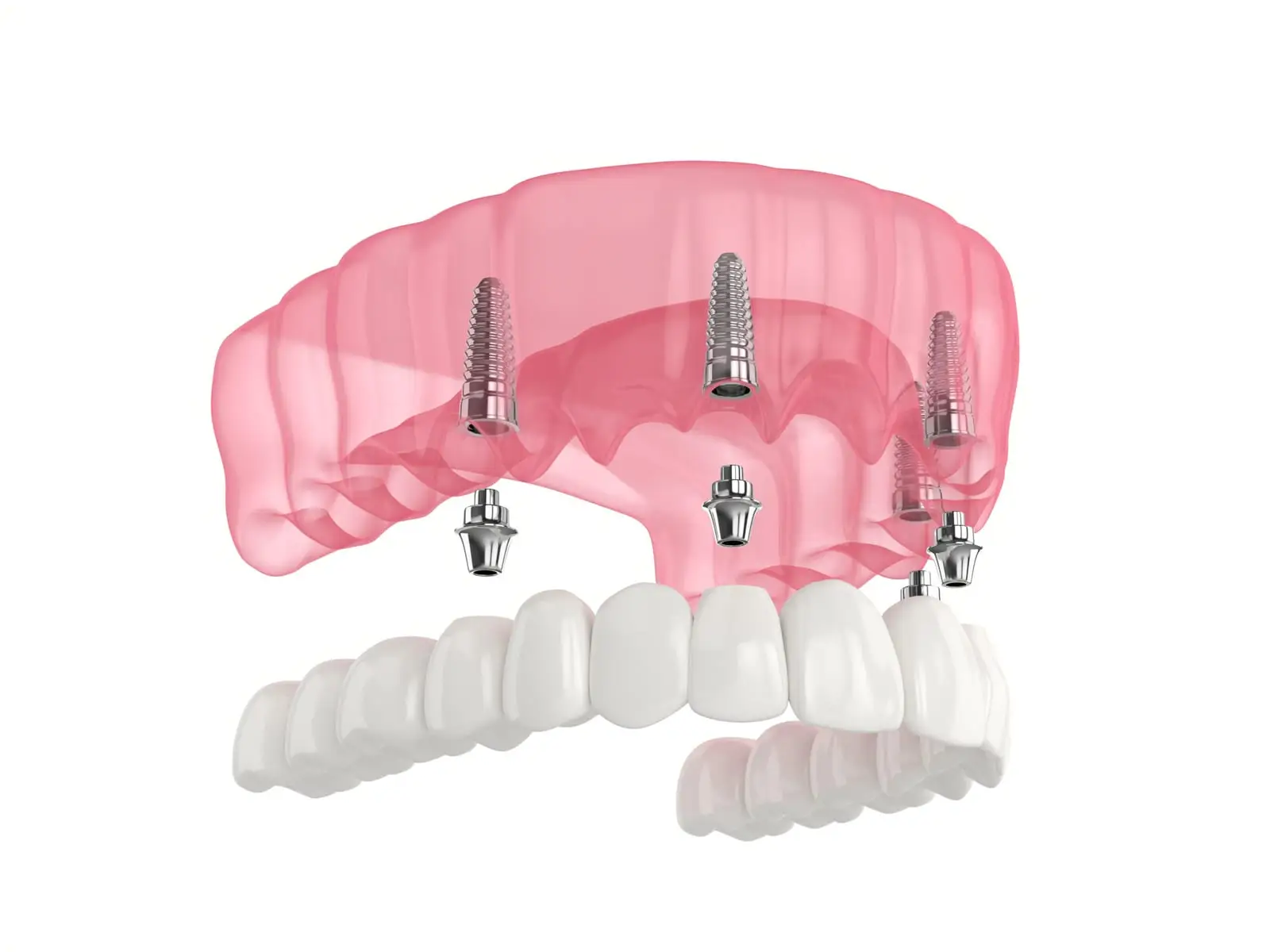
Illustration for education — not a patient case.
- What arrives day one
- A provisional crown or bridge, not the definitive restoration
- Immediate loading defined
- Restored within 48 hours of placement; delayed loading after 8–16 weeks (published comparison)
- Stability thresholds used
- ISQ of 65 or higher, or insertion torque of 35 Ncm or higher, as indicators of primary stability
- Reported outcomes
- 24-month survival 96.0% overall; 92% immediate vs. 96% delayed, not statistically significant
- Immediate placement
- Systematic review of 1,139 implants: all studies reported survival over 90%, with careful case selection
- Final teeth
- After osseointegration, which Cleveland Clinic describes as three to nine months
On this page
What "teeth in a day" actually meansLink to this section: What "teeth in a day" actually means
Two different things get bundled under the phrase, and it helps to separate them.
Immediate placement means the implant goes into the socket at the same visit the tooth is extracted, rather than waiting months for the site to heal. Immediate loading means a restoration is attached to the implant right away instead of leaving it undisturbed. A published comparison of the two protocols defines immediate loading as restoring the implant within 48 hours of placement, and delayed loading as restoring it after 8 to 16 weeks.
Same-day marketing usually promises both. What arrives on day one, in nearly every case, is a provisional — a temporary crown or acrylic bridge that lets you leave with teeth, eat softly, and speak normally. The definitive restoration is made later, after the bone has fused to the implant. Cleveland Clinic describes that fusion, osseointegration, taking anywhere from three to nine months.
This is not a criticism of any office. "Teeth in a day" is a fair description of the patient experience. It is simply not a description of the finished restoration, and the two are worth telling apart before you sign a plan.
Primary stability is what decides itLink to this section: Primary stability is what decides it
An implant can only carry a load on day one if it is gripped tightly enough by bone at the moment it is placed. That grip is called primary stability, and it is measured, not guessed.
The comparison study above used ISQ of 65 or higher, or insertion torque of 35 Ncm or higher, as indicators of primary stability sufficient for immediate loading. ISQ comes from resonance frequency analysis — a small device that reads how rigidly the implant is held. Insertion torque is read from the drill as the implant is seated. Your dentist checks one or both during surgery.
If the numbers come up short, the responsible decision is to leave the implant unloaded and let it heal. That call is made in the operatory, which is why no honest office can guarantee same-day teeth before the implant is in.
What the evidence says about outcomesLink to this section: What the evidence says about outcomes
In the same 24-month comparison, overall survival was 96.0 percent, with 92 percent in the immediately loaded group and 96 percent in the delayed group — a difference the authors reported as not statistically significant. Average marginal bone loss was 0.82 mm with immediate loading and 0.79 mm with delayed loading, again with no significant difference. Immediate loading showed higher early patient satisfaction, though the gap narrowed by the time the definitive restoration was placed.
On placing implants straight into extraction sockets, a systematic review of 20 studies covering 1,139 immediate implants in 904 patients found all of them presented a survival rate over 90 percent, and concluded that immediate placement can be a viable alternative to delayed placement but requires careful case selection and a specific protocol because it is a technique-sensitive procedure, more difficult to execute than the conventional one.
That is the accurate summary: comparable results with the right case, and more demanding to get right.
Who qualifiesLink to this section: Who qualifies
The consistent thread is enough bone, enough stability, and nothing working against healing. Good candidates typically have solid bone at the site, no active infection that cannot be cleaned at the time of extraction, controlled general health, and a bite that will not hammer the provisional.
Full-arch cases are often better suited to immediate loading than single implants, because a bridge splints several implants together and shares the load. That is one reason the All-on-4 protocol is so often planned with same-day provisional teeth.
Who does notLink to this section: Who does not
The immediate-versus-delayed study excluded people who were pregnant or nursing, had parafunctional habits without a splint, had untreated periodontitis, smoked heavily — more than 10 cigarettes daily — had uncontrolled systemic disease, or had local infections. Those exclusions map closely to real-world reasons an office will recommend waiting.
Thin or soft bone is the other common one. If the scan shows a site that needs bone grafting or a sinus lift, day-one teeth are off the table for that site until the graft has matured. The same applies where the implant seats loosely despite good planning.
The honest limitationsLink to this section: The honest limitations
- A soft diet is not optional. The provisional is there for appearance and function, not for chewing hard food. Loading a healing implant too hard is one of the ways it fails.
- Loading too early in poor bone raises failure risk. This is the reason stability is measured rather than assumed.
- The provisional is not the final tooth. Shape, shade, and fit are usually refined in the definitive restoration once the gum has settled.
- Aesthetic risk at the front. In the systematic review of immediate placement, gum recession was more prominent and clinically significant in the immediately placed group in one study, with 92 percent survival for immediate placement versus 100 percent for delayed placement. Front teeth are where that matters most; see front tooth implants.
- Nobody can promise it in advance. The ADA notes that some patients receive implants and replacement teeth in one visit while others wait up to several months.
How the timeline really runsLink to this section: How the timeline really runs
Day one: extraction if needed, implant placement, stability measured, provisional attached if the numbers allow. The following weeks: soft diet, careful cleaning, and follow-up checks. Months two through nine: osseointegration, with Cleveland Clinic's three-to-nine-month range as the reference. Then: the provisional comes off, the implant is scanned, and the definitive crown or bridge is made and fitted. The whole sequence is laid out in the dental implant process, and what the weeks feel like in dental implant recovery.
Asking about it at a consultation in Huntington BeachLink to this section: Asking about it at a consultation in Huntington Beach
Useful questions: Will you measure insertion torque or ISQ, and what threshold do you use? What is the plan if stability is short on the day? Is the provisional included in the quoted fee? How long is the soft diet? When is the final restoration made, and is it priced separately?
The affiliated offices in Huntington Beach and Downey list 3D imaging, guided planning, and sedation among their services. Beachside Dental Group publishes a free consultation including full-mouth X-rays and an examination, and a $699 dental implant placement offer covering placement, exam, and X-rays for new patients — abutment, crown, and sedation are separate, offers cannot be combined with insurance, and terms may change. A scan and an exam are what turn "maybe same day" into a plan. Request a consultation.
Benefits
- You leave the surgical visit with teeth rather than a gap or an empty denture
- Fewer separate surgical visits when extraction and placement are combined
- Published survival and bone-loss results are comparable to delayed loading in well-selected cases
- Higher early patient satisfaction was reported with immediate loading
- Full-arch cases benefit because a splinted bridge shares the load across implants
Limitations & considerations
- The day-one restoration is provisional; the definitive teeth are months away
- A soft diet protects the implants and is not optional during healing
- Loading an implant that lacks primary stability raises the risk of failure
- Gum recession was more prominent in immediately placed implants in one study, which matters most at front teeth
- Whether you qualify is decided during surgery, so it cannot be promised beforehand
What the process looks like
Scan, exam, and a contingency plan
A cone-beam scan shows bone volume and density, and the plan states what happens if stability is short on the day.
Extraction and immediate placement
Where indicated, the failing tooth is removed and the implant placed at the same visit, with any gap around it grafted as needed.
Stability measured
Insertion torque and, in some offices, resonance frequency analysis are read to decide whether the implant can carry a provisional.
Provisional attached or site left to heal
If the numbers allow, a temporary crown or bridge goes on that day; if not, the implant heals undisturbed and a removable temporary fills the gap.
Osseointegration
Months of quiet healing on a protective diet, with follow-up checks, over Cleveland Clinic's three-to-nine-month range.
Definitive restoration
The provisional comes off, the implant position is scanned, and the final crown or bridge is made, tried in, and fitted.
| Feature | Immediate loading | Delayed loading |
|---|---|---|
| Definition | Implant restored within 48 hours of placement. | Implant restored after roughly 8 to 16 weeks. |
| What you leave with | A provisional crown or bridge on the implant. | A removable temporary, or nothing on the implant itself. |
| Requirement | Measured primary stability — ISQ 65 or higher, or insertion torque 35 Ncm or higher. | No load-bearing requirement at placement. |
| Reported survival | 92% at 24 months in the cited comparison. | 96% at 24 months in the same comparison; difference not statistically significant. |
| Marginal bone loss | 0.82 mm average at 24 months. | 0.79 mm average at 24 months; no significant difference. |
| Diet during healing | Soft diet, strictly, to protect the loaded implant. | Soft diet early on, with fewer restrictions once the site closes. |
| Best suited to | Good bone, splinted full-arch cases, and patients who need teeth immediately. | Soft or thin bone, grafted sites, heavy smokers, and untreated gum disease. |
Is it right for you?
Same-day protocols suit people with enough bone for an implant to be gripped firmly at placement, no active infection at the site, and healing that is not compromised. The measurement taken during surgery is the final word, so the plan should always include what happens if stability falls short.
Often a good fit
- Solid bone volume and density at the implant site on a 3D scan
- A full-arch case where implants are splinted by one provisional bridge
- Good general health with chronic conditions well managed
- Willingness to keep to a soft diet through the healing period
Worth discussing first
- Heavy smoking, which the cited protocol treated as an exclusion above 10 cigarettes daily
- Untreated periodontitis or an active infection at the site
- Grinding or clenching without a protective splint
- Thin or soft bone, or a site that needs grafting or a sinus lift first
Questions people ask
Do I really get permanent teeth in one day?
No. What is attached on the day of surgery is a provisional — a temporary crown or acrylic bridge. The definitive restoration is made after the implant integrates with bone, which Cleveland Clinic describes as taking three to nine months. Same-day teeth are real; they are just not the final teeth.
How does the dentist decide whether I can be loaded the same day?
By measuring how tightly the implant is held at placement. A published comparison used ISQ of 65 or higher, or insertion torque of 35 Ncm or higher, as indicators of primary stability adequate for immediate loading. If the reading falls short, the implant is left to heal unloaded.
Is immediate loading riskier than waiting?
In well-selected cases the published difference is small. A 24-month comparison reported 92 percent survival with immediate loading and 96 percent with delayed loading, described as not statistically significant, with almost identical marginal bone loss. The risk rises when an implant is loaded despite poor stability or poor bone.
Can an implant go in the same day the tooth comes out?
Often, yes. A systematic review of 1,139 immediately placed implants found every included study reported survival above 90 percent, while concluding that the technique requires careful case selection and is more difficult to execute than the conventional protocol. Active infection and thin bone are the usual reasons to wait.
What can I eat afterwards?
Soft food, for as long as the treating dentist specifies. A provisional on a healing implant is designed for appearance and light function, not for chewing hard or crusty food. Ask for the specific list and the date the restrictions ease.
What happens if I do not qualify on the day?
The implant is placed and left to heal without a restoration on it, and a removable temporary — a flipper, a retainer with a tooth, or a denture — fills the gap. It is a change of sequence, not a failure, and the final restoration follows on the usual timeline.
Is same-day treatment more likely with a full arch?
It is common with full-arch cases because one provisional bridge splints several implants together and spreads the load, rather than resting on a single implant. The All-on-4 guide covers how that is planned.
Does a same-day implant cost more?
Not inherently. It can reduce the number of surgical visits, while adding the cost of a provisional restoration. What matters is whether the quote itemizes the provisional, the definitive restoration, and what happens if the plan changes during surgery.
Sources
This guide is general dental education and not a substitute for an examination or diagnosis. Treatment recommendations always depend on your individual evaluation at an affiliated office. How it was written and sourced: editorial policy.
Where the consultation happens
Two affiliated offices in Huntington Beach
Beachside Dental Group
Huntington Beach
Pacifica Dental
Huntington Beach
Also in the network: Marina Dentistry (Marina del Rey) and Rio Hondo Dental (Downey).
Talk through same-day implants with a dentist
Request a consultation at an affiliated Huntington Beach office. You'll leave with an itemized, written plan — and no obligation to proceed.