
Dental Implants vs. Bridges
An implant replaces the missing tooth's root and stands alone; a bridge anchors an artificial tooth to the neighbors. Cleveland Clinic states implants last much longer and preserve bone, while bridges are faster, avoid surgery, and are more often covered by insurance. The neighboring teeth and the bone usually decide.
By DICHB editorial teamPrepared from established dental references · clinical review by Dr. Sameer Aljanedi pendingUpdated
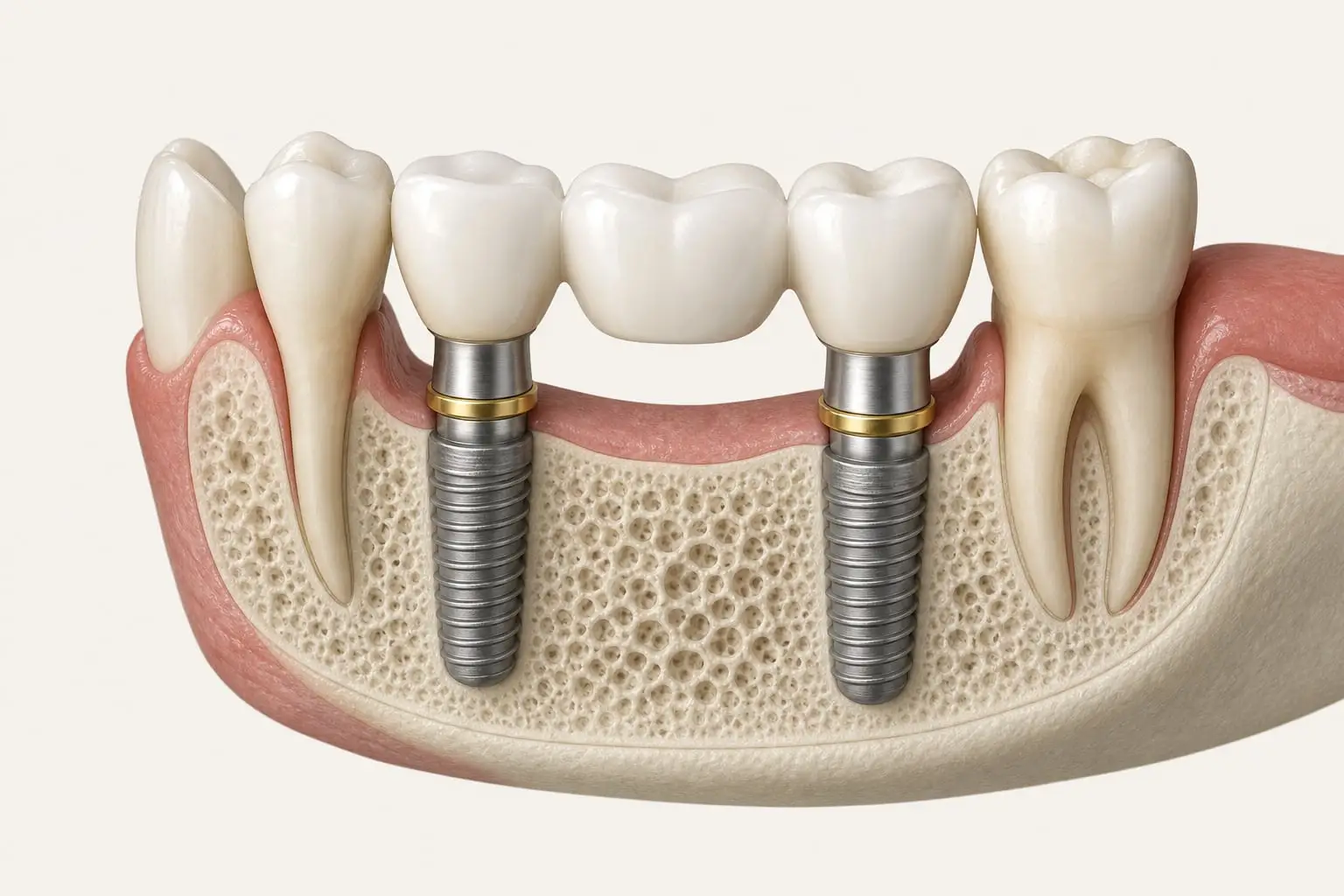
Illustration for education — not a patient case.
- Bridge lifespan
- Cleveland Clinic: five to 15 years on average; Healthline: often replaced every 5–7 years, some last 10+.
- Implant lifespan
- Cleveland Clinic: the implant can last a lifetime with proper hygiene; crowns around 15 years.
- Effect on neighbors
- A traditional bridge requires irreversible enamel removal from the anchor teeth (Cleveland Clinic).
- Bone
- Implants preserve existing bone; bridges do not stop the ridge from shrinking.
- Timeline
- Bridge: about two visits over weeks. Implant: osseointegration of 3–9 months (Cleveland Clinic).
- Insurance
- Bridges are more likely to be covered than implants (Healthline).
On this page
The short answerLink to this section: The short answer
A dental implant replaces the missing tooth's root and stands on its own. A fixed bridge replaces only the crown of the missing tooth, anchoring an artificial tooth to the teeth on either side. Cleveland Clinic states that implants last much longer than bridges and preserve existing bone, while a bridge is faster, avoids surgery, and is more likely to get insurance help. Which is right for you depends on the teeth beside the gap, the bone beneath it, your timeline, and your budget.
How each one worksLink to this section: How each one works
A single-tooth implant is a titanium post placed in the jaw, an abutment connector, and a crown. The post fuses with bone over what Cleveland Clinic describes as three to nine months, and the crown is attached once that is complete.
A traditional bridge, as Cleveland Clinic describes it, consists of dental crowns on both ends with artificial teeth, called pontics, in between. The dentist removes some enamel from the two anchor teeth so crowns fit over them — a step the clinic notes is irreversible — takes impressions, and cements the finished bridge, usually across two visits a few weeks apart. A cantilever bridge anchors to one side only and is weaker. A Maryland bridge uses bonded wings instead of crowns and is mainly for front teeth.
What changes the recommendationLink to this section: What changes the recommendation
Condition of the neighboring teethLink to this section: Condition of the neighboring teeth
This is usually the deciding factor. If the teeth beside the gap are healthy and unrestored, crowning them for a bridge sacrifices sound enamel, and an implant is often preferred because, as the ADA's MouthHealthy notes, it avoids removing healthy tooth structure. If those neighbors already have large fillings, root canals, or worn crowns, a bridge restores three teeth in one step and the trade-off looks very different.
Bone at the siteLink to this section: Bone at the site
An implant needs enough bone to hold the post. A tooth lost years ago, or one lost to infection, may leave a thin ridge that needs bone grafting first, adding months and cost. A bridge does not depend on the bone at the gap, so it can be the practical route when grafting is not wanted or not advisable.
TimelineLink to this section: Timeline
A bridge can be finished in weeks. An implant is a longer project — Healthline describes a timeline of up to six months, and longer if grafting comes first. If you need a fixed tooth quickly, the timeline may tip the decision, although a temporary tooth can fill a front-tooth gap while an implant heals.
Budget now versus laterLink to this section: Budget now versus later
Per tooth, a bridge is usually cheaper up front, and insurance is more likely to help. But a bridge is three units for one missing tooth, and when it fails — decay under an anchor crown is the usual reason — all three are replaced together. Over decades, an implant that is replaced rarely or never can cost less than a bridge replaced more than once. The cost guide itemizes the implant side.
Age of adjacent restorationsLink to this section: Age of adjacent restorations
A seldom-mentioned factor: if a neighbor already has a crown that is fifteen years old, it may need replacing soon anyway, and folding it into a bridge can be efficient. If the neighbor's crown is new, an implant avoids disturbing it.
Longevity, with sourcesLink to this section: Longevity, with sources
Cleveland Clinic states that implants themselves can last a lifetime with proper hygiene and regular dental visits, that crowns and bridges last around 15 years, and, on its bridge page, that the average lifespan of a dental bridge is five to 15 years. Healthline cites a ten-year implant success rate of around 97 percent and says a bridge often has to be replaced about every five to seven years, though some last more than ten. The spread reflects how much hygiene, bite forces, and the health of the anchor teeth matter.
Hygiene and daily careLink to this section: Hygiene and daily care
An implant crown is brushed and flossed like a natural tooth. A bridge has a solid span that traps food underneath it; Cleveland Clinic recommends cleaning beneath it every day with floss threaders. Patients who find flossing difficult sometimes struggle to keep a bridge clean, which matters because decay in an anchor tooth is what usually ends a bridge's life.
Bone preservationLink to this section: Bone preservation
When a tooth root is gone, the bone that held it gradually shrinks. A bridge sits above the gum and does nothing to stop this, which can leave a visible dip under the artificial tooth over time. Cleveland Clinic notes that implants preserve existing bone and reduce the risk of bone loss, and the American Academy of Implant Dentistry describes implants as the only restoration option that preserves natural bone. For a front tooth, this affects how the gum line looks years later.
When a bridge is genuinely the better choiceLink to this section: When a bridge is genuinely the better choice
- The anchor teeth already need crowns.
- Bone is inadequate and you prefer not to graft.
- Health factors make surgery unwise — see who is a candidate for implants.
- You need a fixed tooth within weeks.
- Insurance coverage makes the bridge substantially cheaper and longevity is a secondary concern.
When an implant is usually preferredLink to this section: When an implant is usually preferred
- The neighbors are healthy and unrestored.
- You are replacing a single back tooth that carries heavy chewing load.
- You want to avoid bone loss under the restoration.
- You are comfortable with a longer timeline.
Multiple missing teeth add a third option: an implant-supported bridge puts two implants under a span instead of cutting natural teeth. The guide to multiple-tooth implants covers it.
Deciding at a consultationLink to this section: Deciding at a consultation
A 3D scan shows bone width and height, and an exam shows the condition of the anchor teeth — the two facts that decide most cases. At a free consultation at Beachside Dental Group in Huntington Beach, which includes full-mouth X-rays and an examination, you can ask for both options priced side by side, and the article on what to ask an implant dentist will help you arrive prepared. Request a consultation.
Benefits
- An implant leaves healthy neighboring teeth untouched
- Implants are the longest-lasting option and preserve bone under the restoration
- A bridge is faster, avoids surgery, and often costs less up front
- A bridge can restore neighbors that already need crowns in a single step
- Both are fixed — neither comes out at night
Limitations & considerations
- A bridge puts three units on the line when one anchor tooth decays
- An implant needs adequate bone; grafting adds months and cost
- Bridges require daily cleaning underneath with floss threaders
- Insurance typically favors the bridge, so the upfront difference can be larger than the fee list suggests
What the process looks like
Exam and 3D scan
The dentist checks the anchor teeth and measures bone at the gap.
Two plans priced
Implant and bridge are itemized side by side, including any grafting on the implant side.
Bridge route
Anchor teeth are prepared, impressions taken, a temporary placed, and the bridge cemented at a second visit.
Implant route
The post is placed, heals for months, then an abutment and crown complete the tooth.
Maintenance
Either restoration is checked at regular visits; bridges are cleaned beneath daily.
| Feature | Dental implant | Fixed bridge |
|---|---|---|
| What it replaces | Root and crown; stands alone. | Crown only; anchored to neighboring teeth. |
| Neighboring teeth | Untouched. | Enamel removed for anchor crowns (irreversible). |
| Surgery | Yes, outpatient placement. | No. |
| Timeline | Months; osseointegration 3–9 months (Cleveland Clinic). | Weeks; about two visits. |
| Lifespan | Implant can last a lifetime; crown around 15 years (Cleveland Clinic). | Five to 15 years on average (Cleveland Clinic). |
| Bone at the gap | Preserved and stimulated. | Continues to shrink beneath the pontic. |
| Daily cleaning | Brush and floss like a natural tooth. | Floss threaders under the span every day. |
| Insurance | Less often covered. | More often covered (Healthline). |
| Best when | Neighbors are healthy and bone is adequate. | Neighbors already need crowns or surgery is unwise. |
Is it right for you?
Both options suit a single missing tooth with teeth on either side. The recommendation turns on the health of those neighbors and the bone at the site, which an exam and 3D scan establish.
Often a good fit
- Implant: healthy, unrestored neighbors and adequate bone
- Bridge: neighbors that already have large fillings or aging crowns
- Either: good gum health and a commitment to daily cleaning
Worth discussing first
- Thin bone at the gap without willingness to graft (favors bridge)
- Heavy grinding or a missing back molar under high load (discuss with the dentist)
- Uncontrolled diabetes or smoking, which affect implant healing
Questions people ask
Is a bridge a bad choice compared with an implant?
No. A bridge is a well-established restoration and is often the better choice when the neighboring teeth already need crowns, when bone is limited, or when surgery is not advisable. Its trade-offs are the enamel removed from anchor teeth, a shorter average lifespan, and daily cleaning underneath.
How long does each option last?
Cleveland Clinic states that the implant itself can last a lifetime with proper hygiene and regular visits, that crowns and bridges last around 15 years, and that a bridge's average lifespan is five to 15 years. Healthline says bridges often need replacing every five to seven years. Individual results vary with hygiene and bite forces.
Will an implant damage the teeth next to it?
No. An implant stands on its own and does not involve the neighbors. That is one of the main reasons it is preferred when those teeth are healthy and unrestored.
Can I get a bridge now and an implant later?
Sometimes, but the anchor teeth will already have been crowned, and bone under the bridge continues to shrink, which may mean grafting later. If you expect to want an implant eventually, it is worth discussing that timeline at the consultation.
Which is cheaper?
A bridge is usually cheaper up front and more likely to be covered by insurance. Over decades, a bridge that is replaced more than once can cost more than an implant that is not. Ask for both itemized in writing and compare.
Does a bridge stop bone loss?
No. A bridge sits above the gum, and the bone that held the missing root gradually shrinks. Cleveland Clinic notes implants preserve existing bone, which can matter for how the gum line looks under a front tooth years later.
Sources
This guide is general dental education and not a substitute for an examination or diagnosis. Treatment recommendations always depend on your individual evaluation at an affiliated office. How it was written and sourced: editorial policy.
Where the consultation happens
Two affiliated offices in Huntington Beach

Beachside Dental Group
Huntington Beach

Pacifica Dental
Huntington Beach
Also in the network: Marina Dentistry (Marina del Rey) and Rio Hondo Dental (Downey).
Talk through implants vs. bridges with a dentist
Request a consultation at an affiliated Huntington Beach office. You'll leave with an itemized, written plan — and no obligation to proceed.