
Sinus Lift for Upper Back Implants
A sinus lift adds bone height in the upper back jaw by raising the sinus membrane and placing graft material beneath it. It is needed when the sinus has expanded downward after molars were lost. Implants are sometimes placed at the same visit, and sometimes months later.
By DICHB editorial teamPrepared from established dental references · clinical review by Dr. Sameer Aljanedi pendingUpdated
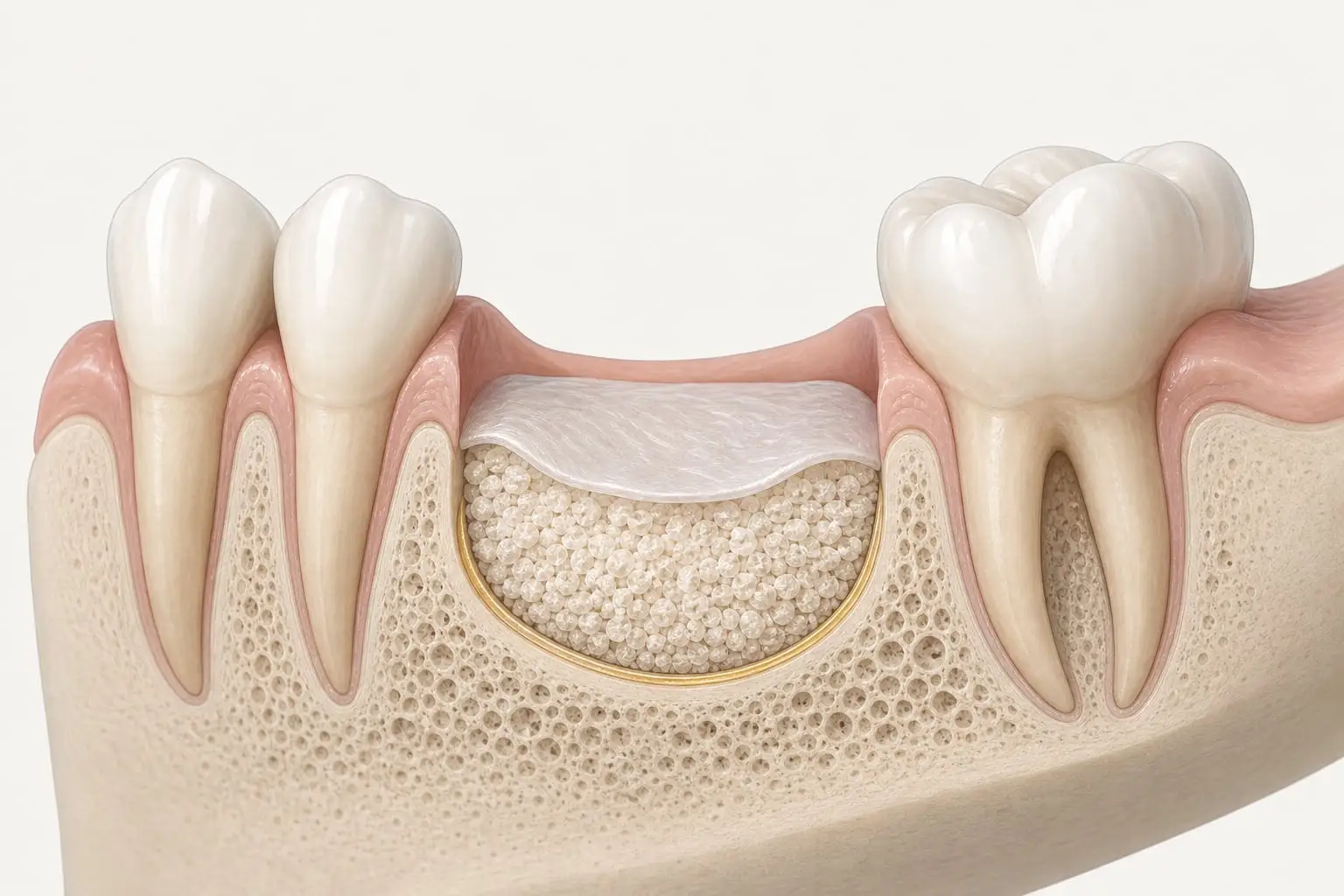
Illustration for education — not a patient case.
- Why it is needed
- AAOMS: tooth loss deep in the upper jaw causes bone thinning and lets the maxillary sinuses expand downward
- Two techniques
- Lateral window for larger height gains; vertical osteotome or crestal for minimal adjustment (AAOMS)
- Technique choice
- A published decision tree favours the transcrestal approach where residual bone height exceeds 6 mm
- Graft materials
- Synthetic, animal-derived, or the patient's own bone (AAOMS); donor bank allograft is a fourth option (Cleveland Clinic)
- Healing
- Cleveland Clinic: grafts need at least three months, large grafts nine to 12; place the implant within six to 12 months of healing
- Perforation rate
- 15.7–23.1% average with the lateral approach; 3.1–6.4% reported with transcrestal, likely underdetected
On this page
Why the sinus gets in the wayLink to this section: Why the sinus gets in the way
The maxillary sinuses are air-filled spaces in the cheekbones, sitting directly above the roots of the upper back teeth. In some people the sinus floor already dips low between the molar roots before any tooth is lost.
Once an upper molar is gone, two things happen at once. The ridge shrinks, as it does anywhere a root is removed, and the sinus expands into the space above. The AAOMS puts it plainly: loss of teeth deep in the upper jaw causes natural bone deterioration and thinning, which can lead the maxillary sinuses to expand downward. What is left between mouth and sinus can be a few millimeters of bone — not enough to hold an implant.
A sinus lift, also called sinus augmentation or maxillary sinus floor elevation, restores that height. The sinus membrane is gently raised off the bone floor, and graft material is placed in the space created beneath it. Over months, that material is replaced by your own bone. This page covers the sinus-specific procedure; the wider picture, including socket preservation and ridge augmentation, is in bone grafting for dental implants.
Two techniques, chosen by how much bone is leftLink to this section: Two techniques, chosen by how much bone is left
The lateral window approach opens a small access window in the outer wall of the upper jaw. The AAOMS describes exposing the bone and creating a small opening to reach the sinus. The surgeon sees the membrane directly, lifts it under vision, and can place a larger volume of graft. It is used when a lot of height must be gained.
The crestal or osteotome approach works upward through the implant site itself, tapping the sinus floor gently to raise the membrane a small distance from below. The AAOMS refers to this as the vertical osteotome technique for cases needing minimal height adjustment. It is less invasive and generally has fewer post-operative complications, but the surgeon is working without direct sight of the membrane.
Residual bone height is the usual deciding factor. A review of anatomical factors and a decision tree for sinus floor augmentation describes the transcrestal approach as the more favorable, minimally invasive alternative where residual bone height exceeds 6 mm, with the choice below that turning on membrane health, lateral wall thickness, and sinus anatomy. The scan, not a rule of thumb, decides which technique fits your jaw. How that scan is read is described in planning implants with 3D imaging.
Graft materialsLink to this section: Graft materials
The AAOMS states that the graft material may be synthetic, animal-derived, or obtained from the patient's own body. Cleveland Clinic's bone graft page describes the same four categories: allograft, human bone from a licensed donor bank; alloplast, a lab-made substitute such as hydroxyapatite; autogenous, your own bone taken from another site; and xenograft, animal-derived bone, commonly bovine or porcine.
All four are used routinely. If the source matters to you for medical, religious, or personal reasons, say so at the consultation.
When the implant goes inLink to this section: When the implant goes in
Sometimes at the same visit, sometimes later. The AAOMS notes that depending on the situation, implants can be placed simultaneously with the sinus augmentation or as a separate procedure. The rule of thumb is stability: if enough native bone remains to grip an implant firmly, it can go in while the graft matures around it. If not, the graft heals first.
Timeframes come from the graft, not the sinus. Cleveland Clinic states that a bone graft needs at least three months to heal, that large grafts can require nine to 12 months, and that once a graft heals it is best to place the implant within six to 12 months, because a new graft will otherwise start to shrink and lose density. The implant then integrates on its own schedule — three to nine months, per Cleveland Clinic. A grafted upper molar site is a staged plan with two healing periods. See the dental implant process.
Recovery: the sinus-specific rulesLink to this section: Recovery: the sinus-specific rules
Standard graft aftercare applies — Cleveland Clinic advises applying ice, eating soft foods, keeping your head elevated, keeping the site clean, taking medications as prescribed, and avoiding disturbing the site, vigorous spitting or swishing, alcohol for two weeks, exercise for 48 hours, and smoking or vaping.
A sinus lift adds rules of its own, because pressure changes in the sinus can disturb a freshly raised membrane and the graft under it. The treating dentist will typically ask you to:
- Not blow your nose forcefully for the period they specify.
- Sneeze with your mouth open, so the pressure escapes rather than pushing upward.
- Avoid drinking through a straw and avoid smoking, both of which create suction.
- Avoid air travel, scuba diving, and heavy lifting or straining for a stated period.
- Take any prescribed decongestant, antibiotic, or nasal spray exactly as directed.
Some swelling and bruising is expected, more than after a small socket graft, and a little blood-tinged nasal discharge on the treated side is not unusual in the first days. Swelling or bleeding that worsens rather than settles, graft particles coming loose into the mouth, fluid or air passing between mouth and nose, or fever should be reported to the treating dentist promptly.
The risks worth knowingLink to this section: The risks worth knowing
The main intra-operative risk is perforation of the sinus membrane. A review of intra-operative complications in maxillary sinus augmentation reports an average perforation frequency of 15.7 to 23.1 percent with the lateral approach, with wide variation across individual studies, and a lower mean rate of 3.1 to 6.4 percent for the transcrestal approach — while cautioning that transcrestal perforations may go undetected because the technique is performed blind. Small perforations are commonly repaired with a resorbable membrane during the same procedure.
The consequence that matters most is sinus infection. The same review reports a higher incidence of sinusitis, 31.4 percent, in cases of membrane perforation, despite attempts to close the perforation. It also describes a strong association between membrane perforation with the lateral approach and smoking, and notes vascular injury as a lateral-approach risk. Cleveland Clinic lists infection, nerve damage, severe bleeding, and anesthesia complications among bone graft risks generally, and states that bone grafts have success rates up to 100 percent depending on the type.
None of this makes a sinus lift an unusual procedure — it is a routine part of implant dentistry — but chronic sinus disease, nasal polyps, or a history of sinus surgery are all worth raising before the plan is made.
Consultation in Huntington BeachLink to this section: Consultation in Huntington Beach
Whether your upper back jaw needs a lift, and which technique fits, comes from a cone-beam scan measuring residual bone height and sinus anatomy. The affiliated offices in Huntington Beach and Downey list bone grafting, 3D imaging, and sedation among their services.
Beachside Dental Group publishes a free consultation including full-mouth X-rays and an examination, and a $699 dental implant placement offer covering placement, exam, and X-rays for new patients — grafting, the abutment, crown, and sedation are priced separately, offers cannot be combined with insurance, and may change. Ask for the sinus lift as its own line on the written plan; it is one of the larger sources of variation between two upper-molar cases. See dental implant cost and who is a candidate. Request a consultation.
When a sinus lift is not the answerLink to this section: When a sinus lift is not the answer
- Enough residual bone already exists, or a shorter implant will do the job.
- The All-on-4 protocol can tilt implants forward of the sinus, which often makes a lift unnecessary in full-arch cases.
- Chronic sinus disease is untreated, in which case an ENT opinion usually comes first.
- Smoking has not stopped, given its association with membrane perforation.
- A bridge, a partial denture, or leaving the space are acceptable to you; see dental implant alternatives.
Benefits
- Makes implants possible in upper back sites that would otherwise have too little bone
- Can be done at the same visit as implant placement when enough native bone remains
- Restores a fixed molar rather than settling for a removable partial denture
- Several graft materials are available, so the plan can match your preferences
- Cleveland Clinic reports bone graft success rates up to 100 percent depending on the type
Limitations & considerations
- It is an additional surgery with its own healing period before or alongside the implant
- Membrane perforation is the most common intra-operative complication
- Sinusitis is substantially more likely when the membrane is perforated
- Recovery restricts nose blowing, straws, flying, and strenuous activity for a stated period
- Chronic sinus disease or smoking complicates both the procedure and the healing
What the process looks like
Cone-beam scan and sinus assessment
Residual bone height, sinus anatomy, septa, and membrane health are measured to choose the technique and decide on simultaneous implant placement.
Anesthesia and access
Local anesthesia with sedation available. A lateral window is opened in the outer jaw wall, or the crestal approach works upward through the implant site.
Membrane elevation
The sinus membrane is carefully separated from the bone floor and raised to create the space that will hold the graft.
Graft placement and closure
Graft material is packed beneath the raised membrane, a barrier membrane is placed where needed, and the site is sutured closed.
Implant placement, now or later
If enough native bone grips the implant, it is placed at the same visit; otherwise the graft matures first and the implant follows.
Integration and restoration
After the implant is placed, osseointegration runs three to nine months per Cleveland Clinic before the crown or bridge is made.
| Feature | Lateral window | Crestal / osteotome |
|---|---|---|
| Access | A window opened in the outer wall of the upper jaw (AAOMS). | Upward through the prepared implant site itself. |
| Height gained | Larger gains, used when a lot of bone must be added. | Modest gains; AAOMS describes it for minimal height adjustment. |
| Visibility | The membrane is lifted under direct vision. | Performed without direct sight of the membrane. |
| Typical indication | Lower residual bone height, or complex sinus anatomy. | A decision-tree review favours it where residual bone height exceeds 6 mm. |
| Reported perforation rate | Average 15.7%–23.1%, with wide variation between studies. | Mean 3.1%–6.4%, though perforations may go undetected. |
| Invasiveness and recovery | More swelling and a longer appointment. | Less invasive, with fewer reported post-operative complications. |
| Implant timing | More often staged, with the implant placed after the graft matures. | More often placed at the same visit when native bone grips the implant. |
Is it right for you?
A sinus lift is considered when a cone-beam scan shows too little bone height between the ridge and the sinus floor at an upper back site where an implant is planned. Sinus health, smoking status, and how much height is needed all shape which technique is used and whether the implant goes in at the same visit.
Often a good fit
- Missing upper molars or premolars with a low sinus floor on the scan
- Healthy sinuses with no chronic infection or untreated nasal disease
- Well-managed general health and no tobacco use
- Willingness to follow the post-operative pressure restrictions closely
Worth discussing first
- Chronic sinusitis, nasal polyps, or previous sinus surgery
- Smoking or vaping, which is strongly associated with membrane perforation in the lateral approach
- Anatomical features such as antral septa or a very narrow sinus
- Unmanaged diabetes or active gum disease, which compromise graft healing
Questions people ask
Why do only upper back implants need a sinus lift?
Because that is the only part of the jaw sitting directly beneath a sinus. The AAOMS explains that losing teeth deep in the upper jaw causes bone deterioration and allows the maxillary sinuses to expand downward, leaving too little height for an implant. Lower jaw sites and upper front sites have different limits, such as the nerve canal or ridge width.
Is a sinus lift painful?
It is done under local anesthesia, with sedation available at the affiliated offices, so the procedure itself should not hurt. Afterwards, expect swelling and soreness for several days — more than a simple extraction, less predictable than a socket graft. Cleveland Clinic describes graft discomfort as manageable with prescribed and over-the-counter measures.
How long before the implant can be placed?
It depends on how much native bone remains. The AAOMS notes implants can be placed simultaneously with sinus augmentation or as a separate procedure. When staged, Cleveland Clinic states grafts need at least three months to heal, and large grafts nine to 12 months, and recommends placing the implant within six to 12 months of the graft healing.
What happens if the sinus membrane tears?
Small perforations are common and are usually repaired during the same procedure, often with a resorbable membrane. A review of intra-operative complications reports average perforation rates of 15.7 to 23.1 percent with the lateral approach. The concern is infection: the same review reports a 31.4 percent incidence of sinusitis in cases where the membrane was perforated.
Why can't I blow my nose afterwards?
Forceful nose blowing raises pressure inside the sinus, which can push against a freshly raised membrane and the graft beneath it. For the same reason you will be asked to sneeze with your mouth open, skip straws, and avoid flying, diving, and heavy straining for the period your dentist specifies.
Can I avoid a sinus lift altogether?
Sometimes. Shorter implants suit some sites, and in full-arch cases the All-on-4 protocol tilts the rear implants forward of the sinus, which often removes the need for a lift. Whether either applies to you is a scan question, and a bridge or partial denture remains an option if you would rather not have the surgery.
Does smoking affect a sinus lift?
Yes. A review of intra-operative complications describes a strong association between membrane perforation during lateral-approach sinus elevation and smoking, and Cleveland Clinic lists smoking and vaping among the things to avoid during graft healing. Stopping before surgery is worth discussing at the consultation.
Will a sinus lift change my breathing or voice?
It should not. The procedure raises the membrane at the floor of the sinus and adds bone beneath it; the airway itself is not altered. Temporary congestion on the treated side during healing is common, but persistent congestion, discharge, or facial pressure should be reported to the treating dentist.
Sources
- AAOMS — Sinus Augmentation: Preparing Sinuses for Dental Implants
- Cleveland Clinic — Dental Bone Graft
- Prevention and management of intra-operative complications in maxillary sinus augmentation: a review (PMC)
- Maxillary sinus floor augmentation: anatomical factors and a decision tree (PMC)
- Cleveland Clinic — Dental Implants
This guide is general dental education and not a substitute for an examination or diagnosis. Treatment recommendations always depend on your individual evaluation at an affiliated office. How it was written and sourced: editorial policy.
Where the consultation happens
Two affiliated offices in Huntington Beach
Beachside Dental Group
Huntington Beach
Pacifica Dental
Huntington Beach
Also in the network: Marina Dentistry (Marina del Rey) and Rio Hondo Dental (Downey).
Talk through sinus lift with a dentist
Request a consultation at an affiliated Huntington Beach office. You'll leave with an itemized, written plan — and no obligation to proceed.