
Full-Arch Dental Implants (All-on-4 & All-on-X)
Full-arch dental implants replace all the teeth in a jaw with one fixed bridge on four to six implants. All-on-4 uses four; All-on-X means the count is chosen for your bone. Temporary teeth can be fitted the same day in qualifying cases, and the final bridge follows after the implants integrate.
By DICHB editorial teamPrepared from established dental references · clinical review by Dr. Sameer Aljanedi pendingUpdated
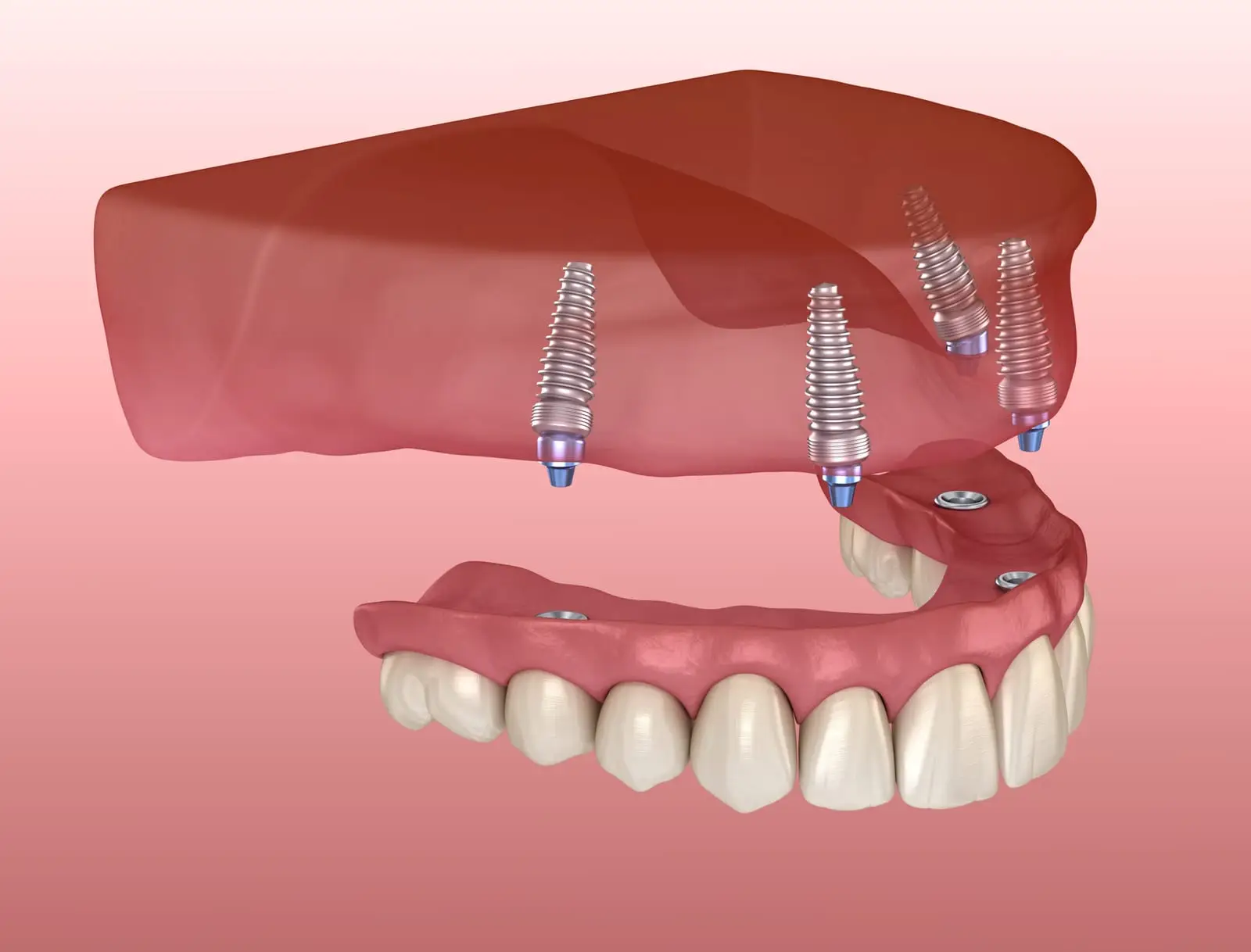
Illustration for education — not a patient case.
- Implants per arch
- Usually four to six, per Cleveland Clinic; All-on-4 uses four, All-on-X a case-specific number
- Fixed or removable
- Fixed; only the dentist removes it
- Same-day teeth
- A temporary bridge can be attached at surgery in qualifying cases; the ADA notes others wait several months
- Integration time
- Three to nine months per Cleveland Clinic before the final bridge
- Final materials
- Zirconia or acrylic on a frame
On this page
What a full-arch fixed bridge isLink to this section: What a full-arch fixed bridge is
A full-arch implant bridge replaces every tooth in the upper or lower jaw with one connected set of teeth screwed onto a small number of implants. Cleveland Clinic describes a full arch as multiple implants, usually four to six, supporting a full arch of teeth. It stays in place day and night, and only the dentist removes it, for cleaning or repair.
All-on-4 is the widely used name for the four-implant version. All-on-X, or All-on-5 and All-on-6, means the same design with the number of implants chosen to fit your bone and bite rather than fixed at four. The X is a placeholder for that number, and the dentist who examines you picks it from the 3D scan rather than from a brand name.
Why the implants are tiltedLink to this section: Why the implants are tilted
In most full-arch designs the two front implants are placed upright and the rear implants are angled. Tilting lets a longer implant engage the denser bone toward the front of the jaw while steering clear of the sinus in the upper jaw and the nerve canal in the lower jaw.
For many people that is the difference between placing implants now and grafting first. Cleveland Clinic notes that where there is not enough jawbone, bone grafts may be needed to build it up; angled placement is one way to work around thin areas and, in qualifying cases, reduce or avoid that extra step. It does not remove the need for grafting in every case, and the scan decides. See bone grafting for dental implants.
Same-day teeth, and what that actually meansLink to this section: Same-day teeth, and what that actually means
Many full-arch cases are planned so that a temporary bridge is attached on the day the implants are placed. The ADA notes that some patients receive implants and replacement teeth in one visit while others wait up to several months before the teeth are attached. Whether you are in the first group depends on how firmly each implant seats in the bone at surgery, which cannot be promised before the procedure.
When a same-day temporary is attached, it is a lighter acrylic bridge designed for the healing period, and a soft diet protects the implants while the bone fuses. Cleveland Clinic describes that fusion taking three to nine months. The final bridge is made once the implants have integrated and the gums have settled into their new shape.
Zirconia versus acrylicLink to this section: Zirconia versus acrylic
Final full-arch bridges are most often made of zirconia, a dense ceramic milled as a single piece, or of acrylic teeth processed onto a metal or reinforced frame. Zirconia is harder, stains less, and generally resists wear and fracture better, which is why many final bridges are made from it. Acrylic is lighter, easier and cheaper to repair chairside, and is the usual material for the temporary bridge.
The choice affects cost, how the bridge wears against the opposing teeth, and how it is repaired years later. It is a conversation for the consultation, not an afterthought.
Who a full-arch fixed bridge applies toLink to this section: Who a full-arch fixed bridge applies to
The design fits people who have lost, or are losing, all the teeth in an arch and want teeth that do not come out. That includes long-time denture wearers who are done with adhesive, and people whose remaining teeth are failing together from decay, gum disease, or a lifetime of dental work. The broader set of options, including removable ones, is compared in full-mouth dental implants.
Candidacy basics are the same as for any implant. Cleveland Clinic requires being done growing with enough healthy bone for the implants to take hold and notes there is no upper age limit; it lists active gum disease, unmanaged diabetes, severe bone loss, and smoking or vaping as problems for healing. The ADA adds that good general health matters more than age. Details are in who is a candidate for dental implants.
What the treatment involvesLink to this section: What the treatment involves
Planning begins with a 3D scan and photographs, and often a trial of the new tooth position so the smile, lip support, and bite are agreed before surgery. A surgical guide made from the scan positions each implant at its planned angle. How the scan drives the plan is in how implant cases are planned with 3D imaging.
Surgery is a single visit under local anesthesia, usually with sedation at the affiliated offices. Any remaining teeth are removed, the bone is shaped, the implants are placed, and, if they seat firmly enough, the temporary bridge is attached the same day. Otherwise a denture is worn during healing.
After integration, the temporary is removed, the implant positions are scanned, and the final bridge is made, tried in, and screwed into place. The full sequence is in the dental implant process.
What to expect and how to maintain itLink to this section: What to expect and how to maintain it
Expect more swelling and a longer soft-food period than a single implant, since extractions and several implant sites are involved. Cleveland Clinic still describes discomfort and swelling as normal, with over-the-counter pain relievers helping and most people feeling normal within a week or so. Worsening swelling or bleeding after the first days should be reported to the treating dentist. Day-by-day detail is in what recovery feels like.
A fixed bridge is cleaned at home with a brush, a water flosser, and floss or interdental brushes where the bridge meets the gum. Cleveland Clinic ties implants lasting a lifetime to brushing, flossing, and regular dental visits, and the AAOMS likewise calls regular check-ups and appropriate oral hygiene essential to long-term implant success. Plan on maintenance visits where the bridge may be removed, cleaned, and re-seated.
Consultation in Huntington BeachLink to this section: Consultation in Huntington Beach
Full-arch consultations at the affiliated offices include 3D imaging and a discussion of sedation. Beachside Dental Group publishes a free consultation including full-mouth X-rays and an examination; its $699 dental implant placement offer applies per implant to placement, exam, and X-rays, with abutments, the bridge, and sedation separate, for new patients, and may change.
Because a full-arch bridge combines surgery, multiple implants, a temporary, and a final restoration, ask for the written, itemized plan before comparing anything. See dental implant cost and financing options.
When a fixed full-arch bridge is not the right choiceLink to this section: When a fixed full-arch bridge is not the right choice
- Several teeth are healthy and savable. Extracting sound teeth to fit a bridge is a trade most dentists will advise against.
- Bone is too thin even for angled implants and you do not want grafting. A snap-in overdenture on fewer implants may be realistic; see implant-supported dentures.
- You want to be able to remove your teeth to clean them, or limited dexterity makes cleaning under a fixed bridge difficult.
- A habit or condition that disrupts healing has not been addressed.
Benefits
- A complete arch of fixed teeth on a small number of implants
- Angled rear implants can reduce the need for grafting in qualifying cases
- A temporary bridge the same day when implants seat firmly enough
- Implants keep the jawbone in use, which the AAID says no other restoration does
- No adhesive, no palate coverage, nothing to take out at night
Limitations & considerations
- Same-day teeth depend on implant stability at surgery and cannot be promised in advance
- The most involved implant surgery, with extractions and multiple sites
- Cleaning under a fixed bridge takes a water flosser and regular professional maintenance
- Higher cost than an overdenture; zirconia costs more than acrylic
- Healthy, savable teeth should not be sacrificed to fit the design
What the process looks like
Consultation and 3D planning
A scan, photos, and a trial tooth position set the implant count, angles, and the look of the new teeth before surgery.
Extractions and implant placement
In one visit under local anesthesia with sedation available, remaining teeth are removed and four to six implants are placed with a surgical guide.
Temporary bridge
If the implants seat firmly enough, an acrylic temporary is attached the same day; otherwise a denture is worn while the sites heal.
Integration
Bone fuses to the implants over a period Cleveland Clinic describes as three to nine months, on a soft diet at first.
Final bridge
Implant positions are scanned, the zirconia or acrylic bridge is made and tried in, then screwed into place.
Maintenance
Home cleaning with a water flosser plus regular visits where the bridge can be removed, cleaned, and re-seated.
| Feature | All-on-4 | All-on-6 / All-on-X |
|---|---|---|
| Implants per arch | Four: two upright, two angled | Five or six, or a count chosen for the case |
| Bone needed | Concentrated toward the front of the jaw | Usually more sites, sometimes more grafting |
| Load sharing | Each implant carries more of the bite | Load spread across more implants |
| If one implant fails | The bridge is more affected | More reserve to keep the bridge in function |
| Surgery and cost | Fewer implants, lower cost | More implants, higher cost |
| Who decides | The dentist, from the 3D scan | The dentist, from the 3D scan |
Is it right for you?
People losing or missing all the teeth in an arch who want fixed teeth, with enough bone for four or more implants or a site that can be grafted, are typically considered. The dentist who examines you decides the implant count and whether same-day temporaries are realistic from a 3D scan.
Often a good fit
- A full arch of failing teeth or a loose long-term denture
- Enough bone, especially toward the front of the jaw, for angled implants
- Good general health with any chronic conditions well managed
- Commitment to home cleaning and maintenance visits
Worth discussing first
- Active gum disease or unmanaged diabetes, per Cleveland Clinic
- Smoking or vaping, which can disrupt healing
- Severe bone loss that rules out even angled placement without grafting
- Heavy clenching or grinding, which stresses the bridge and implants
Questions people ask
What does the X in All-on-X mean?
It is a placeholder for the number of implants. All-on-4 fixes the count at four; All-on-X means five, six, or another number chosen for your bone and bite. Cleveland Clinic describes a full arch as usually four to six implants.
Will I really leave with teeth the same day?
In qualifying cases a temporary bridge is attached at the placement visit. The ADA notes some patients receive implants and teeth in one visit while others wait several months. It depends on how firmly the implants seat, which is judged during surgery, not promised beforehand.
Is All-on-6 better than All-on-4?
Neither is better for everyone. More implants spread the load and give more reserve, but need more bone and cost more. The dentist who examines you chooses the count from the scan.
Zirconia or acrylic for the final bridge?
Zirconia is harder, stains less, and resists wear, so many final bridges use it. Acrylic is lighter and easier to repair and is the usual temporary material. Cost and how it wears against opposing teeth are part of the choice.
Can angled implants really avoid bone grafting?
Often, but not always. Tilting lets implants reach denser bone and avoid the sinus or nerve, which in qualifying cases reduces or avoids grafting. Cleveland Clinic notes grafts are needed where there is not enough bone, and the 3D scan makes that call.
How do I clean a fixed full-arch bridge?
Brush, use a water flosser and floss or interdental brushes where the bridge meets the gum, and keep maintenance visits where it can be removed and cleaned professionally. Cleveland Clinic links implant longevity to that routine.
How long does a full-arch bridge last?
Cleveland Clinic says implants can often last a lifetime with care and that crowns and bridges last around 15 years. The bridge is the part that wears and may be replaced; the implants beneath usually stay.
Sources
This guide is general dental education and not a substitute for an examination or diagnosis. Treatment recommendations always depend on your individual evaluation at an affiliated office. How it was written and sourced: editorial policy.
Where the consultation happens
Two affiliated offices in Huntington Beach
Beachside Dental Group
Huntington Beach
Pacifica Dental
Huntington Beach
Also in the network: Marina Dentistry (Marina del Rey) and Rio Hondo Dental (Downey).
Talk through full-arch (all-on-4 / all-on-x) with a dentist
Request a consultation at an affiliated Huntington Beach office. You'll leave with an itemized, written plan — and no obligation to proceed.