
The Dental Implant Process, Step by Step
Dental implant treatment runs from a planning consultation through implant placement, a healing period while bone fuses to the implant, and a final crown, bridge, or full-arch prosthesis. Straightforward cases take a few months; cases that need extractions or bone grafting can take a year or more.
By DICHB editorial teamPrepared from established dental references · clinical review by Dr. Sameer Aljanedi pendingUpdated
- Osseointegration
- Cleveland Clinic describes bone fusing to the implant over three to nine months.
- Total treatment time
- AAID: from a few months to more than a year for complex conditions.
- Placement visit
- Done under local anesthesia; sedation is available at the affiliated offices.
- Early recovery
- Cleveland Clinic: most people feel like themselves within a week or so.
- Restoration visit
- Cleveland Clinic: attaching the abutment and tooth usually takes about an hour.
- Planning imaging
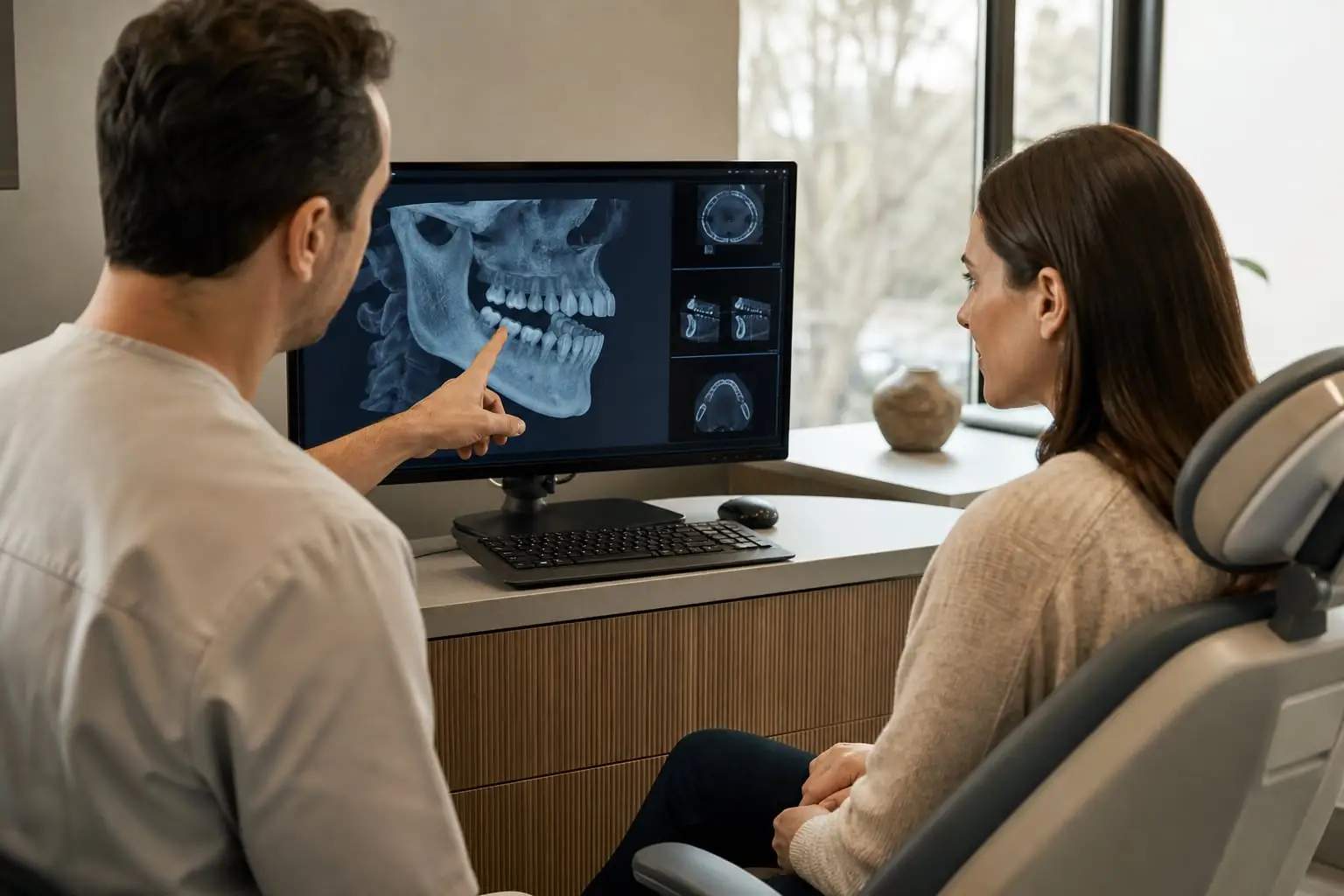
- Beachside Dental Group and Rio Hondo Dental list 3D imaging for implant planning.
On this page
Why the process takes months, not daysLink to this section: Why the process takes months, not days
A dental implant is a small titanium post placed in the jaw to act as an artificial tooth root. The American Dental Association describes implants as posts surgically placed in the upper or lower jaw that serve as a sturdy anchor for replacement teeth. The reason treatment spans months is biological: bone has to grow onto the implant surface before it can safely carry a tooth. Cleveland Clinic describes that fusion, called osseointegration, as taking anywhere from three to nine months.
Every step below exists either to make that fusion more predictable or to build the tooth that sits on top of it. Simple cases skip some steps; complex cases add them.
Step 1 — Consultation and 3D imagingLink to this section: Step 1 — Consultation and 3D imaging
Treatment starts with an exam, a review of your medical history, and imaging. Many implant offices, including Beachside Dental Group in Huntington Beach, use 3D cone-beam scans alongside standard X-rays so the dentist can measure bone height and width, locate nerves and sinuses, and plan the implant position before anything is placed. A separate guide covers what happens at a dental implant consultation in detail, and an article explains how implants are planned with 3D imaging.
You should leave this visit with a written plan: which teeth are being replaced, whether extractions or grafting are expected, the type of final restoration, a timeline, and itemized pricing.
Step 2 — Extraction, if a failing tooth is still presentLink to this section: Step 2 — Extraction, if a failing tooth is still present
If the tooth being replaced is still in place, it is removed first. What happens next depends on the socket. In some cases the implant can be placed into the fresh socket at the same visit, which is called immediate placement. In others the dentist lets the site heal, sometimes with a small graft to preserve the bone, and places the implant weeks or months later, which is delayed placement. The article on how long after an extraction an implant can be placed walks through how that decision is made.
Step 3 — Bone grafting, if neededLink to this section: Step 3 — Bone grafting, if needed
Implants need enough bone to be stable. When a tooth has been missing for years, or when infection has hollowed out the area, the ridge may be too thin or too short. Grafting rebuilds it. Minor grafts are sometimes done at the same appointment as implant placement; larger grafts and sinus lifts are usually done first and left to mature before the implant goes in, which adds months to the overall timeline. The bone grafting guide explains the types of grafts and what each means for your schedule.
Step 4 — Implant placementLink to this section: Step 4 — Implant placement
Placement is a surgical appointment done under local anesthesia, with sedation available at the affiliated offices for patients who want it. Cleveland Clinic outlines the sequence: anesthesia, a small incision in the gum, preparing a precise channel in the jaw with specialized instruments, placing the implant, and closing the gum with stitches. For a single implant the surgical portion is typically brief; full-arch cases take longer because several implants are placed in one session.
Depending on the plan, you may leave with a healing cap on the implant, a temporary tooth that stays out of the bite, or, in some full-arch cases, a temporary fixed bridge the same day. Your dentist will confirm which applies to you.
Step 5 — OsseointegrationLink to this section: Step 5 — Osseointegration
This is the quiet stretch. The implant sits under the gum, or just above it, while bone grows onto its surface. Cleveland Clinic puts the range at three to nine months; the ADA notes that patients may wait up to several months before the replacement tooth is attached, while some receive teeth the same day. Where you fall depends on bone density, whether grafting was done, the location in the mouth, and your overall health. The recovery guide describes what those weeks feel like in practice.
Step 6 — Abutment and impression or digital scanLink to this section: Step 6 — Abutment and impression or digital scan
Once the dentist confirms the implant is stable, a connector called an abutment is attached to it. The abutment passes through the gum and gives the crown something to sit on. At the same visit or shortly after, the dentist takes an impression or a digital scan of the abutment and neighboring teeth so the lab can build a restoration that fits your bite and matches your other teeth. Cleveland Clinic describes this appointment as usually taking about an hour.
Step 7 — Final restorationLink to this section: Step 7 — Final restoration
The finished crown, bridge, or full-arch prosthesis is tried in, adjusted, and secured to the abutment with a screw or cement. Your dentist checks the bite, the contact with neighboring teeth, and how the gum sits around the new tooth. With a single-tooth implant, this visit is usually the last construction step. Multi-unit bridges and full-arch implant teeth may need an extra try-in appointment to get the fit right.
Step 8 — Follow-up and maintenanceLink to this section: Step 8 — Follow-up and maintenance
Implants do not get cavities, but the gum and bone around them can become inflamed if plaque builds up. Expect a check a few weeks after delivery, then routine visits on the schedule your dentist recommends, with cleanings that use instruments suited to implant surfaces. A night guard is often advised for patients who clench or grind.
Realistic timelines: simple vs complexLink to this section: Realistic timelines: simple vs complex
The American Academy of Implant Dentistry describes total treatment as anywhere from a few months to more than a year for more complex conditions, depending on your medical and dental history and the condition of your jawbone. In practice the pattern looks like this:
- A single implant in healthy bone, with no extraction or graft: roughly the osseointegration window plus a few weeks for the restoration.
- An extraction followed by delayed placement: add the socket-healing period before the implant is placed.
- A case requiring a sinus lift or ridge graft: add the graft maturation time, often several months, before placement.
- Full-arch cases: planning is more involved, but some patients receive a temporary fixed bridge on the day of surgery, with the final bridge made after healing.
These are patterns, not promises. The only timeline that applies to you is the one written in your treatment plan.
Immediate vs delayed placementLink to this section: Immediate vs delayed placement
Immediate placement means the implant goes into the socket at the time of extraction. It can shorten the overall timeline and reduce the number of surgical visits, but it requires enough intact bone around the socket to hold the implant firmly, and it is generally avoided when active infection is present. Delayed placement lets the socket heal first, which gives the dentist a more predictable foundation at the cost of additional months. The comparison table below summarizes the trade-offs, and your dentist will recommend one based on your scan.
Where treatment happensLink to this section: Where treatment happens
Consultation requests made through this site are scheduled at one of the affiliated offices: Beachside Dental Group or Pacifica Dental in Huntington Beach, Marina Dentistry in Marina del Rey, or Rio Hondo Dental in Downey. All four are led by Dr. Sameer Aljanedi. The dentist who examines you will confirm which of the steps above apply to your case and in what order. If you are still weighing implants against other options, the guides on implants vs bridges and dental implant cost are useful companions to this one.
Benefits
- A written, staged plan so you know what each visit is for before it happens
- 3D planning lets the dentist place the implant where bone and bite support it
- Temporary teeth are often possible during healing, so you are rarely without a tooth
- Each stage is checked before the next, which lets problems be caught early
- The same sequence scales from one tooth to a full arch
Limitations & considerations
- Healing time is set by biology; it cannot be rushed safely
- Extractions, grafting, or sinus lifts each add months to the timeline
- Several appointments over many months are required, even for a single tooth
- A temporary tooth during healing is not always possible, especially at the back of the mouth
What the process looks like
Consultation and 3D scan
Exam, medical history, X-rays and a cone-beam scan to measure bone and plan implant position. You leave with a written, itemized plan.
Site preparation
Extraction and any needed bone grafting or sinus lift, done at the same visit as placement or months ahead depending on the site.
Implant placement
A short surgical visit under local anesthesia, with optional sedation, to place the titanium post. A temporary tooth may be fitted.
Osseointegration
Bone grows onto the implant over several months. Check-ups confirm the site is healing as expected.
Abutment and scan
A connector is attached and an impression or digital scan is taken for the lab.
Final tooth and follow-up
The crown, bridge or arch is fitted and adjusted, followed by routine maintenance visits.
| Feature | Immediate placement | Delayed placement |
|---|---|---|
| When the implant goes in | Same visit as the extraction | Weeks to months after the socket heals |
| Surgical visits | Usually one | Usually two |
| Overall timeline | Shorter, since socket healing and osseointegration overlap | Longer, since healing happens in sequence |
| Bone needed at the socket | Intact socket walls that can hold the implant firmly | Less critical; a preservation graft can rebuild the site first |
| Active infection at the site | Generally avoided | Infection is cleared before placement |
| Who decides | Your dentist, based on the scan and what is found at extraction | Your dentist, often chosen when the site is uncertain |
Is it right for you?
Most healthy adults with adequate bone can complete the full sequence. Patients whose bone has shrunk after long-term tooth loss, or who have untreated gum disease, often need preparatory steps first. Your dentist confirms the order and timeline after the exam and scan.
Often a good fit
- Adults who have finished growing with stable general health
- Healthy gums, or gum disease that has been treated and is under control
- Enough bone, or bone that can be rebuilt with grafting
- Willingness to attend several visits across months
Worth discussing first
- Active, untreated gum disease
- Unmanaged diabetes or other conditions that slow healing
- Smoking or vaping, which Cleveland Clinic notes can disrupt healing
- Severe bone loss that grafting may not fully resolve
Questions people ask
How long does the whole dental implant process take?
It depends on what your case needs. The American Academy of Implant Dentistry describes treatment as anywhere from a few months to more than a year for complex conditions. A single implant in healthy bone sits at the short end; cases with extractions, grafting, or sinus lifts sit at the long end. Your written plan will give a timeline specific to you.
What is osseointegration and how long does it take?
Osseointegration is the process of your jawbone growing onto the implant surface so it becomes a stable anchor. Cleveland Clinic describes it as taking three to nine months. The implant is not loaded with a final tooth until your dentist confirms it is stable.
Can the implant be placed the same day a tooth is pulled?
Sometimes. Immediate placement is an option when the socket walls are intact, there is no active infection, and the implant can be held firmly. When those conditions are not met, the dentist will let the site heal first. The scan and the extraction itself determine which approach is used.
Will I have a tooth while the implant heals?
Often, yes. Options include a temporary crown kept out of the bite, a removable temporary, or, in some full-arch cases, a temporary fixed bridge on the day of surgery. In some back-of-mouth cases a temporary is not practical. Ask at the consultation so you know what to expect.
How many appointments are involved?
Expect several visits spread across months: consultation and imaging, any site preparation, placement, healing checks, the abutment and scan visit, delivery of the final tooth, and follow-up. The exact count depends on whether extractions or grafting are needed.
What happens if I do not have enough bone?
Bone can usually be rebuilt with grafting, which is done before or alongside placement depending on how much is needed. This adds time but makes the implant more predictable. The bone grafting guide and the article on being told you do not have enough bone cover the options.
Where would my treatment take place?
Consultation requests through this site are scheduled at one of the affiliated offices: Beachside Dental Group or Pacifica Dental in Huntington Beach, Marina Dentistry in Marina del Rey, or Rio Hondo Dental in Downey. Each is led by Dr. Sameer Aljanedi.
Sources
This guide is general dental education and not a substitute for an examination or diagnosis. Treatment recommendations always depend on your individual evaluation at an affiliated office. How it was written and sourced: editorial policy.
Where the consultation happens
Two affiliated offices in Huntington Beach

Beachside Dental Group
Huntington Beach

Pacifica Dental
Huntington Beach
Also in the network: Marina Dentistry (Marina del Rey) and Rio Hondo Dental (Downey).
Talk through implant process with a dentist
Request a consultation at an affiliated Huntington Beach office. You'll leave with an itemized, written plan — and no obligation to proceed.