
Full-Mouth Dental Implants
Full-mouth dental implants replace all the teeth in one or both arches with implants that support either a fixed bridge or a snap-in denture. The choice between a fixed full-arch bridge, an implant overdenture, and a conventional denture comes down to bone, health, budget, and preference, and is staged over months.
By DICHB editorial teamPrepared from established dental references · clinical review by Dr. Sameer Aljanedi pendingUpdated
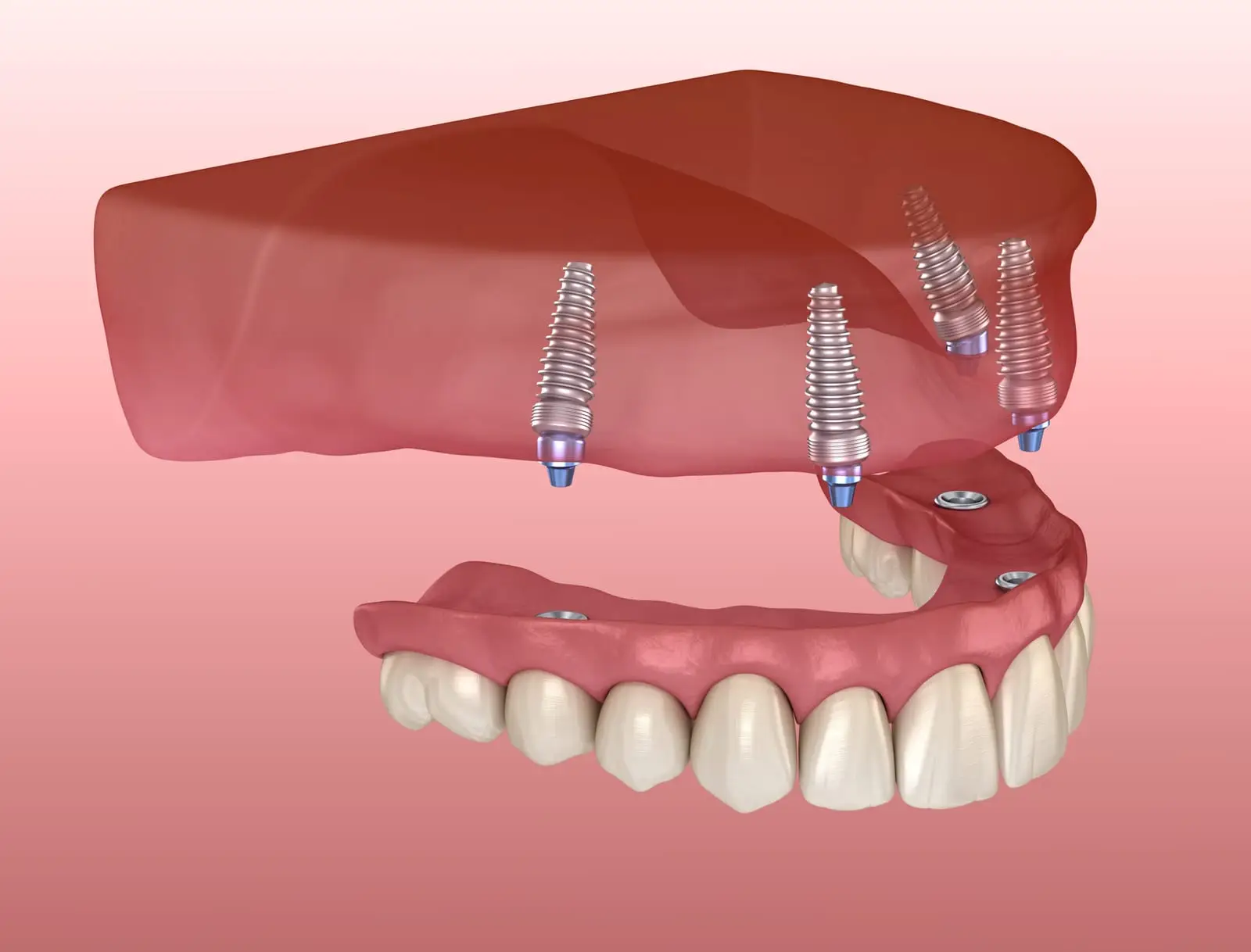
Illustration for education — not a patient case.
- Scope
- All teeth in one arch or both arches
- Fixed option
- Full-arch bridge on multiple implants, usually four to six (Cleveland Clinic)
- Removable option
- Snap-in overdenture retained by two or more implants
- Integration time
- Three to nine months per Cleveland Clinic; overall treatment a few months to more than a year per the AAID
- Staging
- Often one arch at a time, with grafting first where bone is thin
On this page
What full-mouth dental implants meansLink to this section: What full-mouth dental implants means
Full-mouth is a description of the problem, not a single procedure. It covers anyone who has lost all the teeth in the upper or lower arch, or both, and anyone whose remaining teeth are failing together. The implant answer is a small number of implants carrying a complete set of replacement teeth, and there are two main ways to build it.
The first is a fixed full-arch bridge. Cleveland Clinic describes a full arch as multiple implants, usually four to six, supporting a full arch of teeth. It is screwed onto the implants and only the dentist removes it. The marketing names All-on-4 and All-on-X refer to this design, covered in detail in full-arch dental implants.
The second is an implant-retained overdenture, a removable denture that snaps onto attachments fixed to two or more implants. You take it out to clean it, but it does not lift or slide when it is in. The design is explained in implant-supported dentures. Cleveland Clinic groups all of these under the common implant restorations: crowns, bridges, and implant-supported dentures.
How the decision is madeLink to this section: How the decision is made
The dentist who examines you weighs a handful of factors, and being honest about each one usually makes the answer obvious.
- Bone. A fixed bridge generally needs more and better-positioned bone than an overdenture on two implants. A 3D scan shows what is there and whether grafting would be needed for one option but not the other.
- Health and habits. Cleveland Clinic lists active gum disease, unmanaged diabetes, severe bone loss, and smoking or vaping as problems for healing. The ADA adds that chronic illnesses such as diabetes or leukemia may interfere with healing and that tobacco can slow it.
- Your preferences. Some people will not accept anything removable; others are comfortable with a snap-in denture if it stops the slipping they have lived with for years.
- Budget and timeline. More implants and a fixed zirconia bridge cost more and take more visits than two implants and an overdenture, which in turn cost more than a conventional denture.
The fixed-versus-removable question is the one people find hardest, and it is worth reading fixed implant teeth versus removable implant dentures before your consultation.
Who full-mouth implants apply toLink to this section: Who full-mouth implants apply to
Three groups arrive at this page. The first has worn a conventional denture for years and wants it to stop moving, or has noticed the denture no longer fits because the jaw has changed shape. The AAID points out that dental implants are the only dental restoration option that preserves natural bone, which is exactly why old dentures loosen over time.
The second group still has teeth, but they are failing: advanced gum disease, widespread decay, or a mouth of old dental work that keeps breaking. For them the question is whether to keep patching or move to a planned full-arch solution.
The third group has lost teeth recently, often after a long illness or an accident, and is choosing a path for the first time. Candidacy basics apply to all three: Cleveland Clinic requires being done growing, with enough healthy bone for implants to take hold, and notes there is no upper age limit. See who is a candidate for dental implants.
Staging when teeth are failingLink to this section: Staging when teeth are failing
When teeth are still present, sequence matters. A common plan is to extract the failing teeth and place implants at the same visit, attaching a temporary set of teeth if the implants seat firmly enough. The ADA notes that some patients receive implants and replacement teeth in one visit while others wait up to several months for integration; which you are depends on bone and implant stability on the day, and the dentist will not promise same-day teeth before seeing the scan.
When bone is thin, grafting comes first and implants follow after healing. During that stage a conventional or temporary denture keeps you in teeth. The full sequence is in the dental implant process, and grafting decisions are explained in bone grafting for dental implants.
Treating one arch at a time is common. Many people start with the arch that causes the most trouble, often the lower, where conventional dentures are hardest to keep in place, and plan the other later.
What to expect from the timelineLink to this section: What to expect from the timeline
Cleveland Clinic describes bone fusing to implants over three to nine months, and the AAID says treatment can take from a few months to more than a year. A fixed full-arch case typically moves from surgery to a temporary bridge, then to the final bridge once the implants have integrated and the gums have settled. An overdenture case moves from implant placement to attaching the snap-in parts once healing is complete.
Recovery after a full-arch surgery is more involved than a single implant because of extractions and multiple sites. Cleveland Clinic still describes discomfort and swelling as normal and manageable with over-the-counter relief, with most people feeling normal within a week or so; soft foods follow for longer. Worsening swelling or bleeding after the first days should be reported to the treating dentist. Day-to-day detail is in dental implant recovery.
Consultation in Huntington BeachLink to this section: Consultation in Huntington Beach
The affiliated offices in Huntington Beach, Marina del Rey, and Downey all offer consultations for full-arch and full-mouth cases, with 3D imaging and sedation options. Beachside Dental Group publishes a free consultation including full-mouth X-rays and an examination; its $699 implant placement offer applies per implant to placement, exam, and X-rays, with abutments, the bridge or denture, and sedation separate, for new patients, and may change. Costs for full-mouth work vary more than any other implant category, so the written, itemized plan you leave with is the number to trust. See dental implant cost and financing options.
When full-mouth implants are not the right choiceLink to this section: When full-mouth implants are not the right choice
- Several teeth are sound and savable. Keeping them and replacing only what is missing is often better than extracting for a full arch.
- A medical condition or habit is disrupting healing and has not been addressed.
- You are comfortable with a conventional denture and do not want surgery; see dental implants versus dentures.
- The plan being offered skips imaging, grafting discussion, or a written estimate. That is a reason to get a second opinion, not to proceed.
Benefits
- One planned solution instead of repeated repairs to failing teeth
- Implants keep the jawbone in use, which the AAID says no other restoration does
- A choice of fixed or removable designs to match bone, budget, and preference
- Stops the slipping and sore spots of a loose conventional denture
- Can be staged, one arch first, to spread time and cost
Limitations & considerations
- The most involved implant category: extractions, multiple sites, months of staging
- Same-day temporary teeth depend on implant stability on the day, not a promise
- Fixed bridges need more bone and more implants than overdentures
- The widest cost range of any implant treatment
- Health conditions and smoking can rule out or delay treatment
What the process looks like
Consultation and 3D scan
The dentist assesses remaining teeth, bone in both arches, and health, and lays out fixed, removable, and conventional options with a staged timeline.
Choosing the design
Fixed full-arch bridge, snap-in overdenture, or conventional denture is decided on bone, budget, and preference, one arch at a time if needed.
Extractions and grafting
Failing teeth are removed. Where bone is thin, grafting comes first and healing precedes implant placement.
Implant placement
Implants are placed under local anesthesia with sedation available. A temporary bridge may be attached if they seat firmly enough, or a temporary denture is worn.
Integration
Bone fuses to the implants over a period Cleveland Clinic describes as three to nine months.
Final teeth
The final bridge is fitted, or the overdenture attachments are connected, and maintenance visits are scheduled.
| Feature | Fixed full-arch bridge | Snap-in overdenture | Conventional denture |
|---|---|---|---|
| Implants | Usually four to six (Cleveland Clinic) | Typically two to four | None |
| Removable | No; only the dentist removes it | Yes, snaps in and out for cleaning | Yes |
| Stability | Fixed, no movement | Held by attachments, no lifting | Relies on suction, gums, and adhesive |
| Bone | Implants keep bone in use (AAID) | Implants keep bone in use at their sites | Bone continues to shrink |
| Surgery and time | Most involved; months of staging | Moderate; months of healing | None |
| Relative cost | Highest | Middle | Lowest |
Is it right for you?
People who have lost, or are about to lose, all the teeth in an arch can usually be considered for some implant option, provided healing is not compromised. Which option depends on bone, health, and preference, and the dentist who examines you will confirm it from a 3D scan.
Often a good fit
- A loose or ill-fitting conventional denture
- An arch of failing teeth that keeps needing repair
- Healthy gums elsewhere and a commitment to hygiene
- Medical conditions that are well managed
Worth discussing first
- Active gum disease or unmanaged diabetes, per Cleveland Clinic
- Smoking or vaping, which can disrupt healing
- Severe bone loss that makes grafting a prerequisite
- Several sound teeth that would have to be sacrificed
Questions people ask
Do I need an implant for every missing tooth?
No. A full arch is carried on a small number of implants. Cleveland Clinic describes a full arch as usually four to six implants, and snap-in overdentures use fewer.
Can I get new teeth the same day my teeth are removed?
For qualifying cases, a temporary set can be attached at the placement visit. The ADA notes some patients receive implants and teeth in one visit while others wait several months. It depends on how firmly the implants seat, which is decided on the day, not promised in advance.
Should I do the top and bottom at the same time?
Some people do; many start with the arch that gives the most trouble, often the lower, and plan the other later. It is a conversation about recovery, budget, and how the arches will meet.
How long does full-mouth implant treatment take?
Cleveland Clinic describes bone fusing to implants over three to nine months, and the AAID says treatment can run from a few months to more than a year. Grafting first adds time.
I have worn dentures for twenty years. Is it too late?
Not necessarily. Cleveland Clinic notes there is no upper age limit. Long-term denture wear does shrink bone, so a scan decides whether an overdenture on fewer implants, a fixed bridge, or grafting first is realistic. See the article on implants after years of dentures.
Which is better, a fixed bridge or a snap-in denture?
Neither is better for everyone. Fixed bridges feel most like natural teeth but need more bone, implants, and budget. Overdentures are removable but stable, easier to clean, and less costly. The dentist who examines you will lay out both for your bone and goals.
Can I keep some of my natural teeth?
If they are sound, keeping them and replacing only what is missing is often the better plan. Full-arch extraction is reserved for teeth that are failing or cannot be maintained.
Sources
This guide is general dental education and not a substitute for an examination or diagnosis. Treatment recommendations always depend on your individual evaluation at an affiliated office. How it was written and sourced: editorial policy.
Where the consultation happens
Two affiliated offices in Huntington Beach
Beachside Dental Group
Huntington Beach
Pacifica Dental
Huntington Beach
Also in the network: Marina Dentistry (Marina del Rey) and Rio Hondo Dental (Downey).
Talk through full-mouth implants with a dentist
Request a consultation at an affiliated Huntington Beach office. You'll leave with an itemized, written plan — and no obligation to proceed.