
On this page
If an adult tooth has just been knocked out, the first goal is to save it, not to replace it. Pick it up by the crown, put it back in the socket if you can or keep it in milk if you cannot, and get to a dentist right away. The American Association of Endodontists says to act within 30 minutes. A dental implant is the plan for a tooth that could not be saved, and that decision comes later, in a calmer appointment.
This site is an education resource, not a dental office or an emergency line. If you are dealing with this right now, call a dentist, and go to an emergency room if you cannot reach one or if there is heavy bleeding or another injury.
The first few minutesLink to this section: The first few minutes
The AAE and Cleveland Clinic give nearly the same steps for a knocked-out permanent tooth:
- Pick it up by the crown. That is the chewing surface. Do not touch the root.
- Rinse it gently if it is dirty. The AAE says to use only water, with no soap or chemicals, and not to scrub or dry the tooth.
- Put it back in the socket if you can. Hold it in place with your fingers or by biting down gently. Cleveland Clinic suggests biting on a napkin, gauze or handkerchief.
- If it will not go back, keep it moist. The AAE says the tooth must stay moist at all times and lists milk, the space next to your cheek, or an emergency tooth preservation kit. Cleveland Clinic calls milk the best protection. Both advise against storing it in plain tap water.
- Go straight to a dentist. The American Dental Association's patient site puts it simply: get to your dentist's office right away.
Baby teeth are different. Cleveland Clinic says it is not a good idea to reinsert a baby tooth, because doing so may cause problems with the permanent tooth that replaces it. Call the dentist, but leave the tooth out.
How much time you haveLink to this section: How much time you have
The AAE's instruction is to act within 30 minutes, and it adds that it is possible to save a tooth even if it has been outside the mouth for an hour or more. Cleveland Clinic says teeth treated within 30 minutes to one hour have the best chance of success. The practical reading is the same from both: sooner is better, and a delay is not a reason to give up and stay home.
The affiliated offices each have an emergency page: Beachside Dental Group's emergency dentist page in Huntington Beach, Marina Dentistry's emergency dentist page in Marina del Rey, and Rio Hondo Dental's emergency care page in Downey. Whether any office can see you the same day depends on the day and time, so call rather than assume.
What the dentist does with a tooth that was put backLink to this section: What the dentist does with a tooth that was put back
Cleveland Clinic describes the dentist checking that the tooth is in the correct position and placing a splint that anchors it to the neighboring teeth. A root canal may be scheduled if the injury leads to infection in the tooth's pulp. Follow-up is long: a visit about a month after treatment, then every three months for the first year, then annual checks for the next five years.
It is worth knowing the outlook in advance. Cleveland Clinic says a reinserted tooth may stay in place for 10 to 20 years, and that it will eventually loosen or fall out and need replacing. A successful replant buys years, sometimes decades, of your own tooth, which is usually worth having.
When the tooth cannot be savedLink to this section: When the tooth cannot be saved
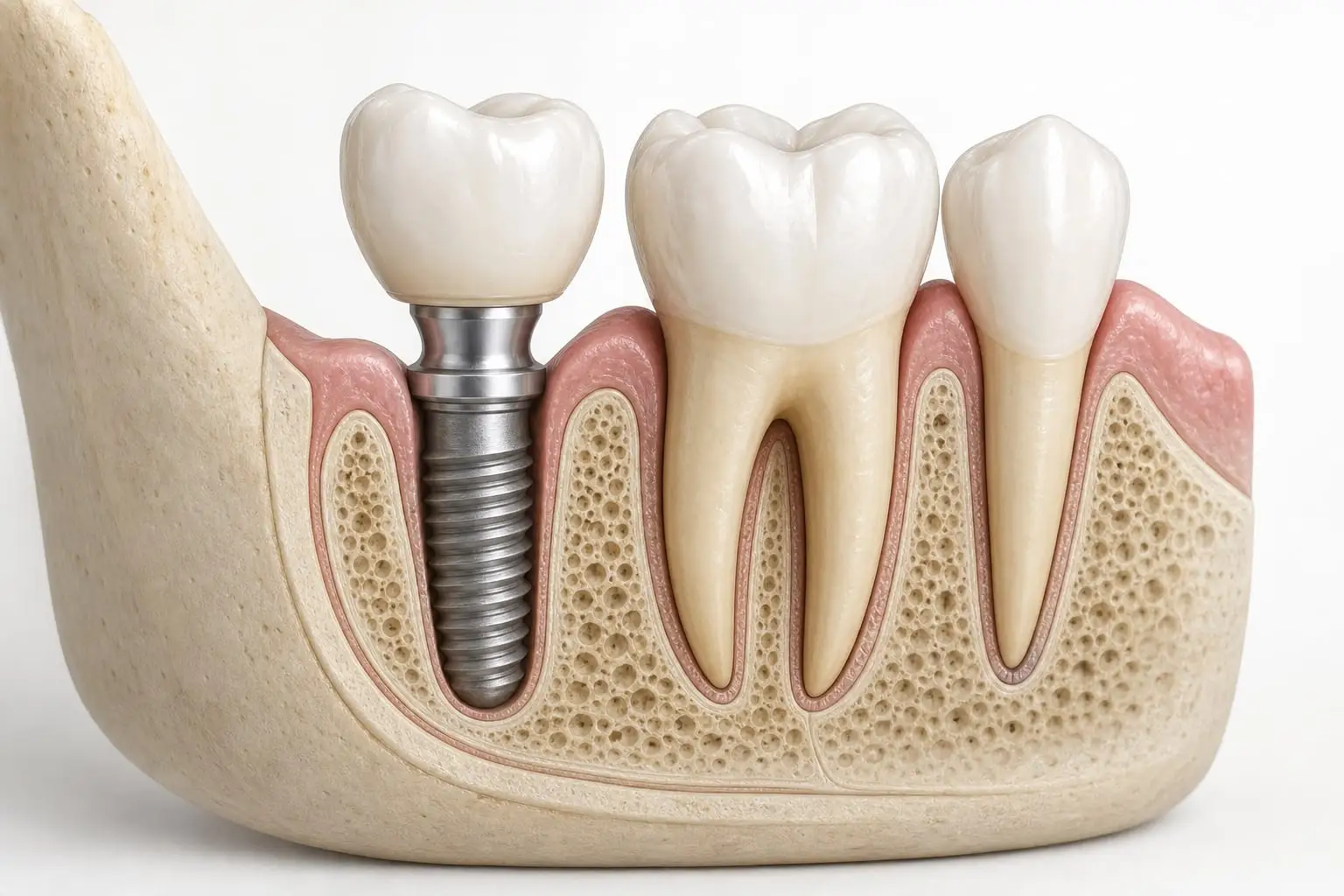
Sometimes the tooth is lost, shattered, or out of the mouth too long. Cleveland Clinic lists the replacement options as a partial denture, a dental bridge, or a dental implant. The dental implant alternatives guide and implants versus bridges compare them in detail.
Three things shape an implant plan after an injury:
- Age. Cleveland Clinic states that the minimum age for implants is typically 18 and that you must be done growing. A teenager who loses a tooth playing sport usually wears a temporary replacement until then.
- The condition of the socket. An impact can damage the bone around the tooth as well as the tooth. The dentist will want imaging before deciding whether an implant can go in soon or the site should heal first. How long after an extraction an implant can be placed explains the timing options, and when bone grafting is needed covers what happens if bone is missing.
- Where the tooth is. A front tooth is judged on appearance as well as function, which makes the planning more exacting. The front tooth implant guide covers why.
Once an implant is placed, Cleveland Clinic describes the bone fusing to it over three to nine months before the final tooth goes on. You are not left with a gap during that time; ask what the temporary tooth will be.
A cracked or broken tooth is a different problemLink to this section: A cracked or broken tooth is a different problem
A tooth that is broken but still in the mouth is not handled the same way. For a cracked tooth the ADA's patient site advises rinsing your mouth with warm water to clean the area and putting a cold compress on your face to keep swelling down, then seeing a dentist. Many broken teeth can be repaired with a filling or a crown, and some need a root canal first. Root canal versus dental implant explains how a dentist decides whether a damaged tooth is worth saving.
Lowering the odds of it happening againLink to this section: Lowering the odds of it happening again
Cleveland Clinic notes that you cannot prevent every knocked-out tooth, but that wearing a mouth guard may protect your teeth during contact sports such as football, basketball or hockey. This matters after an implant too, since the new tooth can be damaged by the same kind of impact. Rio Hondo Dental has a page on custom sports mouthguards that describes how a fitted guard is made.
What to ask at your consultationLink to this section: What to ask at your consultation
- Is there enough healthy bone left at the site, and what does the scan show?
- Can an implant be placed now, or does the site need to heal or be grafted first?
- What will I wear in the gap while it heals?
- If this is for my teenager, when would an implant become possible, and what do we do until then?
- Were the neighboring teeth affected by the injury, and do they need monitoring?
- Should I have a mouth guard made once the tooth is finished?
Next stepLink to this section: Next step
If the tooth was lost and the urgent part is over, the next move is an unhurried evaluation with imaging. Request a consultation at a Huntington Beach office, and read the single-tooth implant guide so the options are familiar before you go.
Quick answers
Can a knocked-out adult tooth be put back in?
Often, if you act quickly. The American Association of Endodontists says to pick it up by the crown, rinse it gently with water, try to put it back in the socket, and see a dentist within 30 minutes. It notes that a tooth can sometimes be saved even after an hour or more.
What should I keep a knocked-out tooth in?
Milk is the usual answer. Cleveland Clinic calls it the best protection, and the AAE also lists holding the tooth next to your cheek or using an emergency tooth preservation kit. Both advise against plain tap water, and the tooth should never be allowed to dry out.
How long does a reimplanted tooth last?
Cleveland Clinic says a reinserted tooth may stay in place for 10 to 20 years, and that it will eventually loosen or fall out and need a replacement. Follow-up visits continue for several years after the injury.
Can a teenager get a dental implant after losing a tooth?
Usually not straight away. Cleveland Clinic states that the minimum age is typically 18 and that you must be done growing before an implant is placed. A temporary replacement is used in the meantime, and a dentist can tell you when the timing is right.
Should a knocked-out baby tooth be put back?
No. Cleveland Clinic says it is not a good idea to reinsert a baby tooth, because it may cause problems with the permanent tooth that will replace it. Call a dentist so the area can be checked.
Sources
This article is general dental education, not personal medical advice — diagnosis and treatment recommendations always require an examination at an affiliated office.