
On this page
For two to four missing teeth, a removable partial denture and dental implants are both legitimate choices, and the right one depends on what you are willing to trade. A partial denture avoids surgery, but it comes out for cleaning, hooks onto your remaining teeth and needs refitting as your mouth changes. Implants stay in place and leave the neighboring teeth alone, but they require surgery, enough healthy bone and several months of healing.
What a removable partial denture isLink to this section: What a removable partial denture is
MouthHealthy, the American Dental Association's patient site, describes removable partial dentures as replacement teeth attached to pink or gum-colored plastic bases. A partial may have a metal framework and clasps that connect to your teeth. It may instead attach with devices called precision attachments, which MouthHealthy says are generally more esthetic than clasps and generally cost more.
Cleveland Clinic explains the support. A partial denture relies on your gums and the underlying bone, and its clasps hook around your remaining natural teeth for additional stability. MouthHealthy adds that crowns on natural teeth are sometimes needed to improve the fit, and are usually required with attachments.
What the implant options areLink to this section: What the implant options are
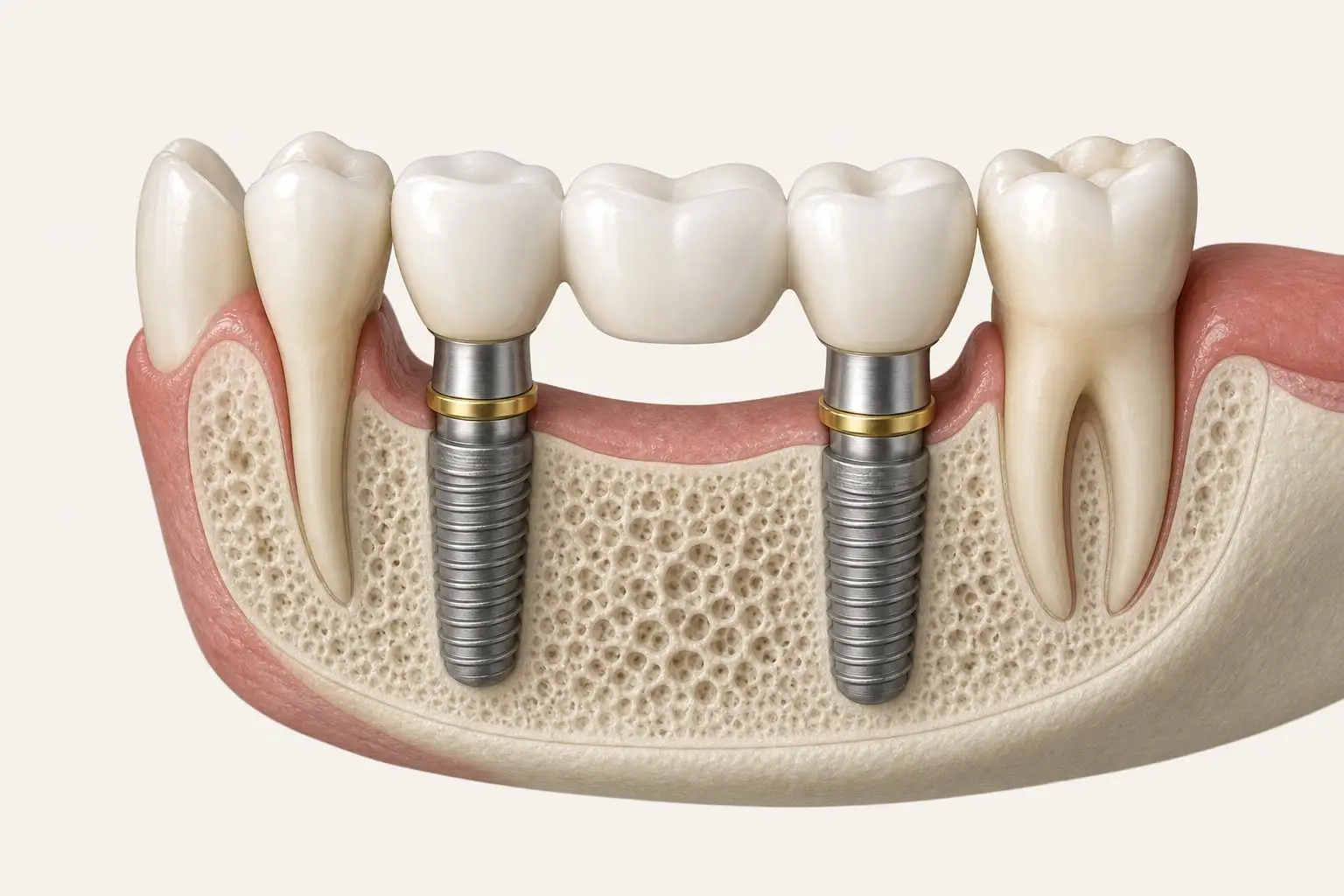
Cleveland Clinic describes dental implants as small, threaded posts that surgically replace missing teeth. Each has a connector and a visible tooth on top. For a few missing teeth there are two common arrangements:
- One implant per tooth, each with its own crown.
- An implant bridge. Cleveland Clinic describes this as similar to a traditional bridge, except that it rests on dental implants instead of natural teeth, and says dentists can use one when you have three or more missing teeth in a row.
How many implants a given gap needs is decided from your scan and your bite. The multiple-tooth implant guide explains the layouts.
A third route is a conventional bridge anchored to the natural teeth beside the gap, which Cleveland Clinic says requires shaving down at least one tooth on either side. Implants versus bridges covers that comparison.
The trade-offs, one at a timeLink to this section: The trade-offs, one at a time
Surgery. A partial denture involves none, unless a tooth has to be removed first. For implant placement, Cleveland Clinic describes an incision in the gum, a small hole made in the jawbone, the implant placed and the gum closed with stitches. It adds that the main requirement is enough healthy bone, and that bone grafts may be needed where there is bone loss. When bone grafting is needed covers that step.
Time. Cleveland Clinic notes that getting the fit of a denture right usually takes several office visits. Implants take longer, because the bone has to fuse to the implant before the final teeth go on. Cleveland Clinic describes that process as taking anywhere from three to nine months.
Getting used to it. MouthHealthy says a new partial denture may feel awkward or bulky at first, and that putting it in and taking it out requires some practice. Cleveland Clinic says it can take weeks, sometimes months, to get used to new dentures. Implant teeth are fixed, so there is nothing to insert or remove.
Daily upkeep. A partial comes out for cleaning. MouthHealthy advises brushing it every day and placing it in soaking solution or water at night, and says your dentist will probably recommend taking it out before bed. Implant crowns and bridges are cleaned in the mouth; for a bridge, Cleveland Clinic advises cleaning underneath every day with floss threaders or interproximal brushes. The dental implant care guide has the routine.
The neighboring teeth. This is the difference people tend to overlook. A partial denture is held by teeth next to the gap, through clasps or attachments, and those teeth may need crowns to make it fit. The ADA notes that dentures accumulate plaque, stains and calculus in the same manner as natural teeth, so the denture and the teeth it touches both need careful cleaning. An implant, in Cleveland Clinic's words, replaces your missing tooth without involving the neighboring teeth.
The bone under the gap. Cleveland Clinic says the jawbone gradually shrinks following tooth loss, and lists jawbone preservation among the advantages of implants. MouthHealthy notes that bone and gum ridges can recede or shrink, resulting in a poorly fitting denture.
How long each lasts. Cleveland Clinic gives the average lifespan of a denture as seven to 10 years and recommends a reline every one to two years, or whenever the fit changes. The ADA says a removable denture should be evaluated for replacement if it is more than 5 years old, or if there is a change in the teeth supporting a partial. For implants, Cleveland Clinic says an implant can last a lifetime with proper care, while most crowns and bridges last around 15 years. These are general figures, not predictions for one person, and how long dental implants last looks at what affects them.
Cost. Cost is often why people start with a partial denture, and that is a legitimate reason to choose it. Ask for both options as written, itemized plans. The dental implant cost guide explains what drives the implant figure.
When a partial denture is the sensible choiceLink to this section: When a partial denture is the sensible choice
- Surgery is not advisable for you right now, for health or medication reasons.
- The remaining teeth have an uncertain outlook, and the dentist would rather not commit to a fixed plan yet.
- You need something to wear while an implant site heals.
- The patient is a teenager. Cleveland Clinic states that the minimum age for implants is typically 18 and that you must be done growing.
- The budget does not stretch to implants at the moment.
Choosing a partial now does not usually close the door on implants later. Bone can change in the meantime, so ask the dentist what waiting is likely to mean in your case. What happens if you don't replace a missing tooth covers the changes that follow tooth loss.
When implants tend to be the better fitLink to this section: When implants tend to be the better fit
- The teeth beside the gap are healthy and you would rather not have them clasped or crowned.
- You want teeth that stay in and are cleaned in place.
- You have enough bone, or are willing to have a graft.
Cleveland Clinic lists conditions that can make someone a poor candidate, including active gum disease, unmanaged diabetes and severe jawbone loss, and notes that smoking or vaping can disrupt healing. The dental implant candidates guide goes through them.
Where to read about dentures themselvesLink to this section: Where to read about dentures themselves
This site concentrates on implants, so dentures and bridges are described on the affiliated offices' own sites. Rio Hondo Dental, the affiliated office in Downey, has a page on full and partial dentures and another on denture repair and relines. Marina Dentistry covers dentures and bridges in Marina del Rey, and Beachside Dental Group has a dentures and bridges page for Huntington Beach.
What to ask at your consultationLink to this section: What to ask at your consultation
- Which teeth would a partial denture clasp onto, and would any of them need crowns?
- How many implants would my gap need, and would it be single crowns or an implant bridge?
- Do I have enough bone for implants, and what does the scan show?
- How often would a partial need relining, and what happens when it wears out?
- If I start with a partial, can I move to implants later, and what might change in the meantime?
- Which would you choose for this gap, and why?
Next stepLink to this section: Next step
The comparison becomes concrete once someone has looked at your teeth, your bite and a scan. Request a consultation at a Huntington Beach office, and read the dental implants versus dentures guide beforehand so the terms are familiar.
Quick answers
Is a partial denture or an implant better for two or three missing teeth?
It depends on what matters most to you. A partial denture avoids surgery but is removable and attaches to your remaining teeth. Implants are fixed and do not involve the neighboring teeth, but they need surgery, enough bone and months of healing. A dentist can tell you which your mouth suits.
How long does a partial denture last compared with an implant?
Cleveland Clinic gives the average lifespan of a denture as seven to 10 years, with a reline every one to two years. It says an implant can last a lifetime with proper care, and that most crowns and bridges last around 15 years. Individual results vary.
Does a partial denture affect the teeth next to the gap?
It relies on them. Cleveland Clinic describes clasps that hook around the remaining natural teeth, and the ADA's patient site says crowns on natural teeth are sometimes needed to improve the fit. Cleveland Clinic says an implant replaces a missing tooth without involving the neighboring teeth.
Can I start with a partial denture and get implants later?
Usually, yes. Starting with a partial does not normally rule out implants later. Cleveland Clinic notes that the jawbone gradually shrinks following tooth loss, so ask the dentist what waiting is likely to mean for the bone at your site.
Do I have to take a partial denture out at night?
Most likely. The ADA's patient site says your dentist will probably recommend taking a partial denture out before bed, and that it should be placed in soaking solution or water at night so it keeps its shape.
Sources
This article is general dental education, not personal medical advice — diagnosis and treatment recommendations always require an examination at an affiliated office.